Showing posts with label Elizabeth Ferrars. Show all posts

Thursday, November 9, 2023

Books Read in September and October


I am late in reporting on my reading for the previous two months. I read 7 books in September and 6 books in October. Most of the books were crime fiction, but I did read one nonfiction book and three non-genre fiction books. All in all it was two months of good reading. 


Nonfiction

Something Wholesale (1962) by Eric Newby

This is a memoir by Eric Newby, a renowned British travel writer. It is mostly about the years he was working in the family garment business. I plan to read more books by this author. My review here.


General Fiction

The People on Platform 5 (2022) by Clare Pooley

I first saw this book at Cath's Read-warbler blog. Her review was posted in early September and I had read this by September 17th, so I must have purchased it almost immediately. This book is contemporary fiction about a group of people who commute to work by train at the same time every day. They never talk to each other, until one day there is an event that brings them together, eventually. The central character is Iona Iverson, 57 years old, working for a magazine as an advice columnist. She is treated abysmally at work, although at one time her writing for the magazine was in different areas and in very much demand. The remaining characters were of various ages, including a teenager in school and adults of various ages in different work environments. I loved this book. Each person has their talents that they end up sharing  with others, and each has a problem that needs to be solved. Some of the results were predictable, but not all. The US title of this book is Iona Iverson's Rules for Commuting.


Today a Woman Went Mad in the Supermarket: Stories (2020) by Hilma Wolitzer

This short story collection contains 13 stories by Hilma Wolitzer. Eight of the stories in the book are vignettes of events in the life of a couple, Howard and Paulie (Paulette), starting with a story about the birth of their first child. Some of these are funny, some are sad, and all are told from the point of view of the wife. My review here.


I Capture the Castle (1948) by Dodie Smith

Rose (20), Cassandra (17), and Thomas Mortmain (15) live with their father and stepmother in a decrepit old house that is attached to an equally decrepit castle. The setting is the English countryside in the 1930s. This book is beloved by many and has many good points but I did not enjoy reading it. My review here.


Crime Fiction

The Eighth Detective (2020) by Alex  Pavesi

This is a mystery with an unusual structure. Grant McAllister, a professor of mathematics, wrote a mathematical theory of the structure of mystery stories and published a book in the late 1930s with seven short stories to illustrate his theory. He then moved to a remote island and retired. Thirty years later a company wants to republish the book of short stories and sends an editor to review the stories with him. This book includes the text of all seven stories, so it is almost like reading a short story book. See my review.


Death in the Fifth Position (1952) by Edgar Box

From 1952-1954, Gore Vidal wrote three mystery novels as Edgar Box. They all featured public relations specialist Peter Sargeant. This first book in the series is set in the world of ballet in New York. I liked the characters, the picture of a ballet production, and the time setting. I also read the third book in the series, Death Likes it Hot.


Generation Loss (2007) by Elizabeth Hand 

This is the first of four books in the Cass Neary series. The main character is a photographer who was famous for one book she published in the 1970s, but she has gone downhill since, and has mostly spent her time working in a bookstore, not pursuing her photography. An old friend offers her the opportunity to interview her idol, Aphrodite Kamestos, who now lives on a secluded island in Maine. The setting is fantastic, dark and cold and threatening. My review here.


Messenger of Truth (2006) by Jacqueline Winspear

This is a series that many readers love but I did not get past the third book. After 11 years I tried the fourth book; I liked it better than the first three books but still did not like it that much. I didn't connect with any of the characters, but I do like the picture of life in the UK in 1931. I am not giving up and I have several more books in the series that I got at the book sale in September.


Greenwood (2019) by Michael Christie

This is a multigenerational family story with a focus on nature and ecology, especially trees. The author is Canadian and the story is set in various parts of Canada. It starts in a dystopian future in 2038 but soon travels back to follow the previous generations of the Greenwood family. This book was nominated for Best Novel by the Crime Writers of Canada in 2020, and it won, but I have yet to figure out why it was considered crime fiction. There are crimes that take place, and mysteries that run through the story, but it is not like any other crime fiction I have read. It is a great read in any case. My review here.


Gambit (1962) by Rex Stout

Rex Stout is my favorite author, so of course I loved this book. I had not read it in years because I can remember the ending. The Nero Wolfe series is fun to read because Wolfe has so many quirks. He hates to leave his home, thus he needs Archie Goodwin to do the legwork for him. He loves spending time caring for his orchids and eating good food. However, this book has one of the most straightforward plots of the 33 novels that Rex Stout wrote. Less of the quirks are evident or emphasized. My review is here.


Something Wicked (1983) by E.X. Ferrars

This is the first in the Andrew Basnett series.  This book is set around Christmas although the Christmas setting is not a focal point. Andrew Basnett is a retired botanist, widowed, in his mid-seventies. He is living in his nephew's house while his nephew is away; all the neighbors in the surrounding area are strange, and many of them are unlikeable. I have liked everything I have read by Ferrars, including this book. However, I would not start here if you have never read anything by this author. She is known as Elizabeth Ferrars in the UK. 


Vera Wong's Unsolicited Advice for Murderers (2023) by Jesse Q. Sutanto

Vera Wong is sixty years old, widowed, and lives alone above her tea shop in San Francisco. One morning when she goes downstairs to start on her walk, there is a dead body of a man on the floor of her tea shop, a man she does not recognize. See my review.


The 7½ Deaths of Evelyn Hardcastle (2018) by Stuart Turton

This book is a roller coaster ride that takes the reader to a world that doesn't make sense. The author describes it as a "time travelling, body hopping murder mystery novel."  A man wakes up with amnesia, and when he finds a decrepit old country house nearby, complete with butler and guests, he is told that he is Sebastian Bell, a doctor. Later in the day, he wakes up in another body and realizes that this is not just a case of amnesia. Along the way he finds out that he has a mission to find out who is going to kill Evelyn Hardcastle, and only by doing this can he be returned to his previous life, which he has no memory of. The entire story was very confusing but I enjoyed it. I was disappointed in the ending. It wasn't that it wasn't a satisfying solution, but there was not enough explanation of the machinations of body hopping. The journey was wonderful, but the destination was not, at least for me.


The photos in this post are of some flowers we planted together in a pot in early summer. The one below is a geranium (or pelargonium) but the plant at the top I can't identify. The geraniums in the pot are still blooming beautifully, in the back, even with no sun. The other plants don't last so long.

Photos taken and processed by my husband. Click on the images for the best viewing quality.


Sunday, January 22, 2023

Books Read in December 2022


The first three books I read in December were Christmas mysteries, and I enjoyed that very much. I wish I could have reviewed them all. In addition I finished up an anthology of Christmas stories that I have been reading off and on for several years. Three other books I read had connections to Christmas but that was unintentional—a pleasant surprise.


Fiction

O Caledonia (1991) by Elspeth Barker

This book is short, about 190 pages long, and the only novel that Barker published. It is set in Scotland in the 1950s.  The story is about a young girl, part of a large family, who is willful and stubborn, and won't be molded into what others want her to be, even from a very early age. It is a sad story but a wonderful read, written so beautifully that it makes me sad that the author did not write any other novels. 


Crime Fiction

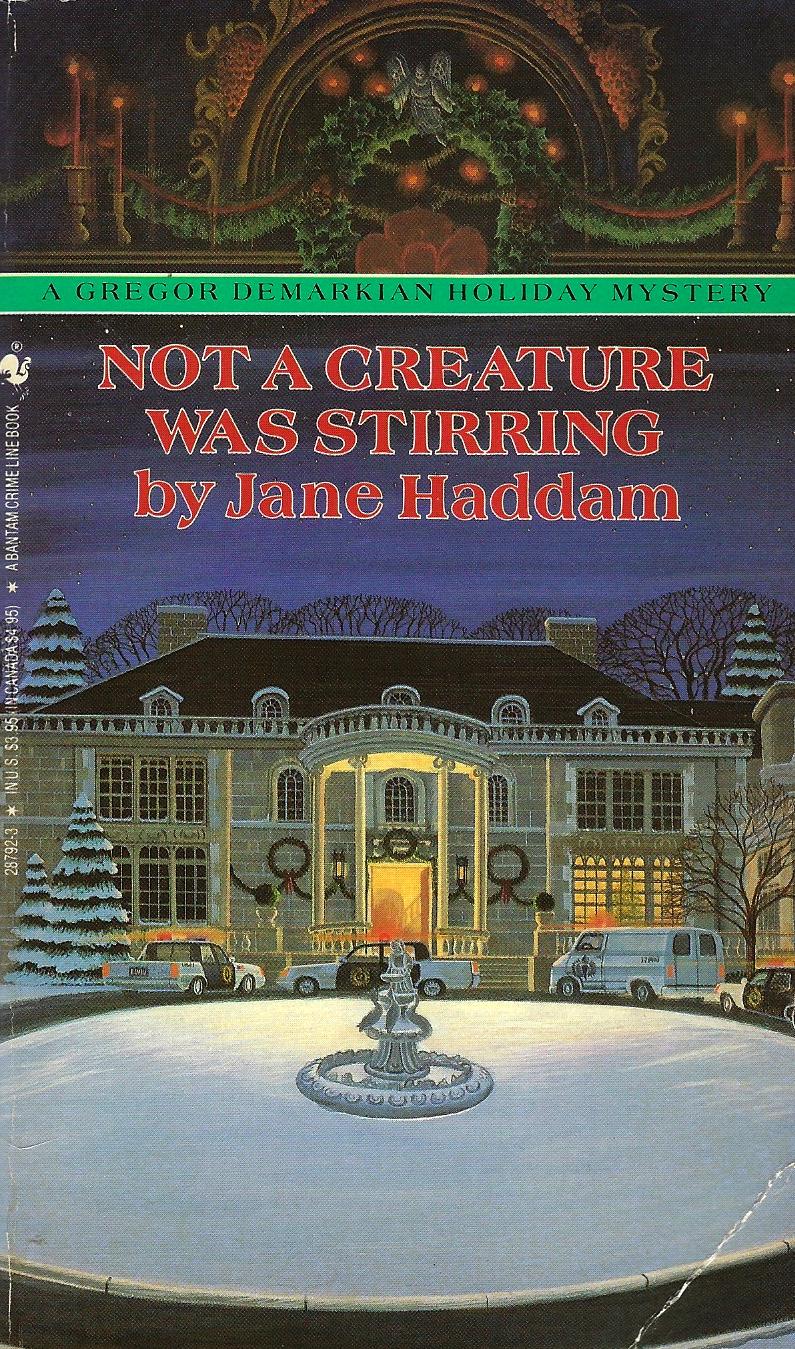
Not a Creature Was Stirring (1990) by Jane Haddam

This is the first book in the Gregor Demarkian series by Jane Haddam. The story in this book is set at Christmas, and has a Christmas theme throughout. My review here.


Smoke Without Fire (1990) by E.X. Ferrars

This book is #6 in the Andrew Basnett series and I read it out of order, usually a no-no for me. Andrew Basnett is a retired botanist, widowed, in his mid-seventies. He is visiting friends for the Christmas holidays, but I would not really call it a Christmas mystery. I have enjoyed every book I read by this author, whose books are published under Elizabeth Ferrars in the UK. My review here.


Murder After Christmas (1944) by Rupert Latimer

This is a book from the British Library Crime Classics series, and only became available in the US in October 2022. It is most definitely a Christmas mystery and it is about the strangest family I have ever met in fiction (or otherwise).  It was a bit too long, too humorous in a screwball comedy way for me. But overall I enjoyed it a lot. I liked the policemen involved especially. And it was written and set during World War II, an extra bonus.


A Death of No Importance (2018) by Mariah Fredericks

There were a lot of things I liked about this historical mystery set in 1910 New York. This is the story of a young woman who works as a lady's maid for the two daughters of a rich family. There is an unfortunate romance, a death, and the maid is the one who finds the body. The police want to pin the murder on anarchists who have been sending threatening notes. The maid narrates the story and I liked that part of it especially. It is a good picture of New York at that time and I liked the way it ended. 


Mistletoe Mysteries (1989) edited by Charlotte MacLeod

This is an anthology of Christmas stories published in 1989. All of the stories have a copyright date of 1989 and were first published in this anthology. I liked all the stories in this book. In 2020, I posted a review of three stories from the book.


The Mysterious Mr. Quin (1930) by Agatha Christie

The short stories in this book feature Mr. Quin and Mr. Satterthwaite. Mr. Satterthwaite is an elderly man, quite well off financially, a bit of a snob, and loves good food and comfort. Mr. Quin is more mysterious, often showing up unannounced to help with a puzzle. How and where this happens is what provides the variety in the stories. I read the first eight stories in the book in January and reviewed them HERE. I read the remainder of the stories in December.


Death in the Off-Season (1994) by Francine Mathews

This is the first novel in the Merry Folger Nantucket Mystery series, and the first novel she wrote. Merry is a new detective in the Nantucket police, working under her father. The death of Rusty Mason, whose family was prominent in Nantucket years before, is her first murder case. This book was on my list of top ten novels in 2022. See my review here.


Snow (2020) by John Banville

I liked this much more than I expected, especially the setting, Ireland in 1957. See my review here.


Currently reading?

I am happy to say that I finished reading Anna Karenina by Leo Tolstoy in early January. It only took me four months. I ended up enjoying most of the second half much more than I liked the first half. Now I am reading The Six: The Lives of the Mitford Sisters by Laura Thompson. I have only read bits and pieces about the Mitford sisters and I want to know more.


End of Year notes

I read 88 books in 2022. The shortest book was a mystery, Dead in the Water by Ted Wood, at 136 pages. My longest book was 752 pages, although I suspect at least 50 of those pages were end notes, etc. The book was Carry Me Home: Birmingham, Alabama, a nonfiction book about civil rights struggles in Birmingham in 1963. I lived in B'ham at the time, but I was a teenager and don't remember much. I am about the same age as the author, Diane McWhorter, who lived in a much more affluent part of the Birmingham metropolitan area at the time. Later she realized the extent to which her family and family friends had been involved, and wanted to learn more about it. A very good book, well researched, but depressing to read.

Of the 88 books I read, 48 books were from my TBR pile, which was my goal. I am only aiming at 60 books this year in my Goodreads Challenge, and still aiming at 48 books from my TBR pile, so we will see how that goes. 


The images at the top and bottom of the post were taken on a recent visit to Rocky Nook Park, in the Mission Canyon area. Mission Creek runs through the park and has been dry for a long time; I wanted to see how much water was in the creek. Water was rushing through the creek and it sounded wonderful. We had a lovely walk.

My husband took the photos. Click on the images for the best viewing quality.


Saturday, December 24, 2022

Smoke Without Fire: E.X. Ferrars


When I saw this book by E.X. Ferrars  at the book store, and saw the lovely Christmas cover, I wanted to read it right away. But it was #6 in the Andrew Basnett series and I had not read any of the other books in the series. Luckily I ran into a great review of this book at Kate's blog, crossexaminingcrime. She assured me that it would be OK to read this series out of order, so I did and it was.

Andrew Basnett is a retired botanist, widowed, in his mid-seventies. He is visiting friends for the Christmas holidays. Colin Cahill and Andrew had been on staff at the same college in London for many years. Cahill and his wife had moved to Berkshire; their son lives with them, working in a nearby town. The family and Andrew have been invited to Sir Lucas Deardon's home for Christmas dinner. Unfortunately Sir Lucas returns to Berkshire from London a day early, and is blown up by a bomb in the lane by his home.

The first question is whether Sir Lucas was the intended victim, as he wasn't expected home at that time. If not, who was the bomb intended for? The lane that leads to Sir Lucas home would only be used to reach one other home, the Cahills. Could the Cahill's son, Jonathan, be the intended victim? The police inquire into the various relationships between the Cahills and Sir Lucas's relations, some living with him and others living in London. 

Andrew seems to me to be an accidental sleuth. He is not really intending to find the murderer, but he can't ignore the situation. He can't help being curious, and people like to talk to him.

There is a lot of talk in this mystery. Andrew talking to the family he is staying with. Andrew talking to various members of Sir Lucas's family. So if you don't like talky mysteries, this may not appeal. Fortunately I enjoy Ferrars' writing and this mystery was very appealing to me. 


Based on the books I have read so far by this author, her books are more about the people than the crimes. The crime exists but it seems to me to provide a framework for Ferrars to delve into the psychology and relationships among the characters. 

E.X. Ferrars was born Morna Doris MacTaggart. In the UK her books were issued under the name "Elizabeth Ferrars." She was a very prolific writer. I would guess that she published at least 60 books between 1940 and 1995. I have read three of her standalone books, and I liked all of them.


-----------------------------

Publisher:   Felony & Mayhem, 2022 (orig. pub. 1990)
Length:      182 pages
Format:      Trade paperback
Series:       Andrew Basnett #6
Setting:      UK
Genre:        Mystery, set at Christmas
Source:      I purchased my copy.


Wednesday, June 29, 2016

Murder Among Friends: Elizabeth Ferrars


From the dust jacket flap of my reprint edition, this is the setup for the crime and the events that follow:
In war-time London, wardens are checking for lights in the blacked-out streets,  but inside Cecily Lightwood's flat, behind its thickly curtained windows,  a party is in progress. Talented, vibrant Cecily has invited people from the literary and artistic world in which she moves. ... Everyone is waiting for the arrival of Aubrey Ritter, the handsome and famous playwright who has just moved into the flat upstairs following the suicide of his wife. 
Ritter's non-appearance dominates the evening, distressing or annoying guests in differing degrees -- until the party is finally shattered by a voice shouting wildly on the stairs and the discovery of Ritter's savagely murdered body.
The protagonist of this novel, Alice Church, is a guest at the party. She is a friend of Cecily's but all of the other guests are strangers to her. Cecily has invited her expressly to meet Janet Markland, a successful businesswoman who works in publishing and is a partner in a literary agency. Janet is the only person who leaves the party before the murder and when she returns her behavior is strange. The evidence indicates that no one else could have murdered Ritter. Her actions following the discovery of the body are suspicious. Thus she is quickly arrested, brought to trial, and eventually convicted of murder.

Yet Alice cannot believe that Janet is the murderer and she cannot leave the issue alone. She finally decides to question some of Janet's friends from the party. She is on a quest to understand why Janet killed Aubrey Ritter or find another solution to the crime.


There are so many things I liked about this book. Some of them are characteristics of other books I have read by Ferrars and some are unique to this book.

The book is set in London during the second World War and was written around that time. The effects of the war and the situation in London at the time are very much a part of the story.
[Janet and Alice are talking at the party.] 
"Was it still raining when you got here?" Janet went on, attempting in the midst of some preoccupation to sound interested in what she was saying. 
"No," said Alice, "it's cleared up, it's a rather beautiful night at the moment. It's very starry. I found a warden and a policeman discussing astronomy on the doorstep." 
"Astronomy?" said Janet. "Really?" 
"Yes. That's something good that's come out of the black-out, isn't it?" said Alice. "All sorts of people have suddenly gotten interested in astronomy."
What people are wearing is usually described in detail in Ferrar's novels, and in this case, is of importance to the mystery plot. As is noted in Whodunit?, edited by H.R.F. Keating, "Her people are notably real. They eat; they choose clothes."
Alice later found that she had no difficulty whatever in remembering her first impression of Kitty Roper. Probably few people ever had.... She came into the room ahead of Cecily, smiling already and full of interest and pleasure. She was a big woman, shaped with a splendid, healthy plumpness, she was rather untidy and  more than a little flashy. Her coat was of a grey Indian lamb, worn over a scarlet woolen dress which was held in round her far from slender waist by a belt of gilded leather. She had a heavy gilt necklace round her throat and chunks of gilt screwed on to the lobes of her ears. With her fair hair, done up in a gaudily striped turban, showing on her forehead in a cluster of dishevelled curls, with her fresh, fair skin, blue eyes and soft, full lips, gaily daubed with few haphazard strokes of lipstick, she was like some magnificent doll, come to exurberant life.
Ferrar's books are more about the people than the crimes. The crime exists and it certainly was always in the back of my mind while reading this book, but in this case it provides a framework for Ferrars to delve into the psychology and the buried motives of the characters' behavior.  This story is much more a part of the psychological suspense sub-genre than Ferrar's other books that I have read. The first one I read, Skeleton in Search of a Cupboard (1982) is a straightforward mystery plot; the second, The Small World of Murder, is more of a psychological thriller.

For me, this book had some of the problems of amateur sleuth mysteries; how does Alice successfully get all these people to talk to her, people that she barely knows? Of course, she isn't really trying to solve a crime, although she does have doubts. She seems to be more obsessed with figuring out who Janet was underneath her persona. A good deal of the story is Alice's conversations with other people. Eventually her husband agrees that are are serious questions to be asked and gets involved.

Although this type of story is not for everyone, I do recommend it highly, primarily for the look at London and its people during the war, but also for the character development and revelations.

H.R.F. Keating also included this book in Crime & Mystery -- The 100 Best Books. There he says:
"During the course of her hesitant inquiries she comes across facts of life likely among a somewhat bohemian set of people. It is a mark of the realism Elizabeth Ferrars achieved that her regular publishers declined the book on the grounds that detective stories could not be this seamy."

Elizabeth Ferrars was born Morna Doris MacTaggart. In the US her books were issued under the name "E.X. Ferrars." She was a very prolific writer.

See other reviews at Pining for the West, In Reference to Murder, and A Hot Cup of Pleasure.

This book is a submission for the Golden Vintage Scavenger Hunt in the "Staircase" category.

 -----------------------------

Publisher:   Constable, 1987 (orig. pub. 1946) 
Length:       191 pages
Format:      Hardcover
Setting:      UK, mostly London
Genre:        Mystery
Source:      I purchased this book.

Sunday, December 20, 2015

The Small World of Murder: Elizabeth Ferrars

From the book summary at Goodreads:
It is not the happiest of journeys to the other side of the world for a family Christmas. Nina Hemslow knows that when she accepts the invitation to join her wealthy friends, Nicola and Jocelyn Foley, for the Foleys had recently lost their only child - a daughter who vanished without trace from her pram outside a supermarket, and whom police and parents are convinced is dead.
The story opens with Nina, Nicola, and Jocelyn beginning their trip from Heathrow airport. They unexpectedly meet an old friend of Jocelyn's, Bill Lyndon. Bill is returning to Australia after visiting his sister in London, and Jocelyn is joining his brother Adrian for Christmas in Australia. Along the way, the group visits Mexico, then Fiji, and finally New Zealand. Bill joins them for a few days in Mexico. At several stops along the way, there are strange mishaps; both Jocelyn and Nina express their fears that the other is trying to get rid of them. This becomes a very uncomfortable situation for Nicola.

I found this to be a great read, although the suspense for most of the book is just figuring what is going on. The first death occurs over 50% into the book, and even at that point it is not clear why. Are both members of the couple unbalanced because of the loss of their child? Why does Bill keep inserting himself into their activities? In the end it all makes sense, although there is a bit of melodrama.

This is a very different Christmas mystery (for those of us not living in or near Australia). It is during the summer and very hot.
[In Fiji]   Jocelyn, who had his very expensive German camera with him, took photographs of mountain and shore, of straw huts and flaming flowering trees. One of these, drenched in fiery red blossom, was call a Christmas tree and was a reminder that Christmas was only three weeks ahead. A Christmas that would feel very strange, coming as it would at the peak of the Australian summer.
And several weeks later in Australia, Sergeant Furness, a detective, is asking Nina about her whereabouts at the time of the murder:
"My word, if you want to commit a crime, my advice is, do it in the afternoon of Christmas Day. Everyone's had too much to eat and drink, and it's hot, and they'll have been swimming, if they've had the chance, so what do they want to do but sleep, and who's going to see anything? You really didn't hear or see anything?"
I love Ferrars' descriptions of people, of their relationships, even their clothes. She often describes how people dress and I never find it to detract from the story; the descriptions fit right in.

She describes Sergeant Furness:
... a tall, fleshy man with greying hair and a round, unexpressive slab of a face. He was wearing a light grey suit, a mauve shirt and a highly coloured tie, in which he looked far more as if he had come from a party than to investigate a death. Probably his clothes were what he had put on for his Christmas festivities.
I have only read one other book by Ferrars, Skeleton in Search of a Cupboard. It was a gift from Moira at Clothes in Books, primarily because of the skeleton on the cover.  I liked that book a lot.

I happily found The Small World of Murder and one other book by Ferrars at the Planned Parenthood book sale this year, on the last day I visited the sale. Serendipitously, this book was set at Christmas, so it fit perfectly into my Christmas reading.

I have enjoyed the two books by Ferrar that I have read. They are moody and I like the writing. It is never quite clear who the "good guys" are vs. the "bad guys." Everyone seems very normal, but there is something strange going on beneath the surface. Yet they don't give me the uncomfortable feeling I get when reading Ruth Rendell's non-series books.  In Rendell's books that I have read, you can generally tell who is evil or manipulative; in Ferrar's I am never sure until the end. I don't contend that her books are better than Rendell's non-series books; they just suit me better.

Elizabeth Ferrars published a lot of books, from 1940 through the 1990s. Some were series books; around 30 books with five series characters. There were also at least 40 standalone books. Her books were published under the name E. X. Ferrars in the US. I would like to try some of her series novels and also more of the standalone books.

 -----------------------------

Publisher:  Penguin Books, 1976 (orig. pub. 1973). 
Length:     159 pages
Format:     Paperback
Setting:     Australia, Mexico, Fiji, New Zealand, UK
Genre:      Mystery
Source:    Purchased at the Planned Parenthood book sale, 2015.

Sunday, May 25, 2014

Skeleton in Search of a Cupboard: Elizabeth Ferrars

From the description of the book on the front flap of the dust jacket:
The luncheon-party in honour of Henrietta Cosgrove's eightieth birthday had gone very well. Her five stepchildren had gathered to celebrate in her lovely old thatched house and to enjoy the food prepared by Freda, the narrator/wife of one of them. Suddenly Henrietta dropped a bombshell. To shore up her dwingling income, she proposed to have valued with a view to selling two landscapes by a painter whose work had recent appreciated. The more practical suggestion that she should sell the over-large house instead threw the Cosgroves into confusion, for it was a suggestion to which several of them were violently opposed. That night the house burned down...
It looks like a case of arson, and that is the first mystery. But the fire reveals more mysteries hidden in the house, and starts a very uncomfortable series of events for the Cosgroves.


As noted above, the story is narrated by Freda, the wife of a younger son in the family, Peter. Henrietta's husband and the father of the five children, Raymond, had two sets of children by his previous two wives. Three children by the first wife and two children by the second. Peter is much younger than his siblings by the first marriage so there is less of a bond. It gets very complicated.

A lot of exposition is provided on the history and the relationships, and I enjoyed all of that. I am partial to books with first-person narration, and Freda's place in the family gives her the perfect perspective (vantage point) to tell the story without being privy to all the background.

I enjoyed this story and found it suspenseful and entertaining. There were several mysteries to follow but I did not get lost in the complexity. There is no real sleuth in this story.  Detective-Superintendent Beddowes investigates the house fire and related issues, but he is not involved directly in the story. If anyone at all is trying to figure out all the mysteries, it is Freda's husband, Peter, but Freda is not always privy to his actions. I would compare it to some of Robert Barnard's stand alone novels, and to a certain extent like Ruth Rendell's non-Wexford novels (although I haven't read a lot of those). The story definitely does not have the uncomfortable tension of Rendell's novels.

This book came to me via Moira of the Clothes in Books blog. Knowing that I collect books with skeletons on the cover, and that I wanted to try a book by Elizabeth Ferrars, she kindly sent me this book for my collection. I am so very grateful to her. Both the cover and the title are wonderful. I think it is a great example of Ferrars' writing and it has enticed me to try more books by the author.

And I will include an extract with clothing descriptions...
'Of course, if I'd known you were all coming, I'd have dressed for the occasion,' she went on. 'Here I am in my old blouse and skirt and all of you looking so smart....'
Her blouse and skirt, both of a soft lavendar shade, might be old, but she looked very trim in them. Beryl's new two-piece was dark green, which went well with her reddish hair. I had put on a jersey dress of coral colour, and Peter had been coaxed into his one good suit which he could normally be cajoled into wearing only when he had been invited to drinks by some of our more elderly acquaintances in the village, who might be put out if he appeared in a sweater and corduroys. His hair, luckily, was at the stage when it was neither too short nor too long and he was looking, I thought, remarkably handsome.
But even I, deeply though I loved him, could not persuade myself that he was as handsome as his half-brother, Martin.
At this point the narrator goes on to describe everyone else in the room, their looks, their clothes, their demeanors and quirks. It is a good introduction to the characters we have not met already. There is a large cast of characters to keep track of throughout the book.

From what I have read, online and in my mystery reference books, this book is not typical of all of Ferrars' novels. Ferrars wrote a lot of novels (see her Fantastic Fiction page for a list); I counted approximately 45 stand alone novels and 30 series novels (5 different series). Her first book was published in 1940, the last in the 1990's. The earlier books are said to be fairly-clued mysteries.  I am guessing there was a lot of variety in the types of mysteries she wrote. There are several others I plan to try.

Links to posts on other novels by Elizabeth Ferrars:


 -----------------------------

Publisher:  Collins Crime Club, 1982
Length:  181 pages
Format:  Hardcover
Setting:  English village
Genre:  Mystery