Showing posts with label Fiction. Show all posts

Friday, August 28, 2026

Middlemarch: George Eliot

I read Middlemarch by George Eliot for my 20 Books of Summer list. I had never been interested in reading Middlemarch until recently, but my husband was interested in the book and found a nice copy at the September book sale in 2022. Then in the spring  of this year I got interested in the book myself. I started reading it on June 4th and finished reading on July 4th. It was quite an experience.


A summary of Middlemarch at the publisher's website:

A triumph of realist fiction, George Eliot’s Middlemarch: A Study of Provincial Life explores a fictional nineteenth-century Midlands town in the midst of sweeping change. The proposed Reform Bill, the new railroads, and scientific advances are threatening upheaval on every front. Against this backdrop, the quiet drama of ordinary lives is played out by the novel’s complexly portrayed characters—until the arrival of two outsiders further disrupts the town’s equilibrium. Every bit as powerful and perceptive in our time as it was in the Victorian era, Middlemarch displays George Eliot’s clear-eyed yet humane understanding of characters caught up in the mysterious unfolding of self-knowledge. 


For me, this was a book about marriages. Some of them were happy and some of them were unhappy, but all of them had bumps along the road. The story begins with Dorothea Brooke's engagement to Mr. Casaubon. Dorothea is nineteen and Casaubon is in his fifties, a clergyman and a scholar. Later, Dr. Tertius Lydgate, who is new to Middlemarch, courts Rosemond Vincy, who has a very high opinion of herself and is used to spending money as she pleases. Both of these couples go into their marriage with very little knowledge of their future spouses. 

My focus on the relationships of these characters may be misleading, because their stories and the stories of many others in the book give us a picture of life in provincial England in the early 1830s, and the many changes that were going in the nation and the world at the time. 


My experience with reading Middlemarch

I usually try not to read reviews of a book before I begin reading it. I don't want to know any plot points in advance. However, in this case, that probably was not a good idea. Although I had read suggestions to take time to read the book, I really did not plan to spend that much time on it. Otherwise I would not have put it in on my 20 Books of Summer list.

Once I got started I got bogged down immediately. I would estimate that the first 200 pages were very hard for me to read; I was not enjoying the writing style or the characters. At times I wondered if I could finish the book. The next 300 pages improved and I started liking all the separate story threads, some of them intertwining. The last 300 pages were very good and I was motivated to read more each day.

My takeaway from all of this is that anyone reading this for the first time should plan to spend a good bit of time on the book. I personally would not make it a year-long read, but I should have read the book at a more leisurely pace. 


What did I like best about Middlemarch?

How the story is told:

The narration in this book really impressed me. The narrator often breaks off and seems to have a conversation with the reader about the characters and their behavior, or admonishing the reader to have sympathy for some of the most unsympathetic characters. The narrator sometimes slips from third-person narration to first-person narration, which can be jarring but it kept me paying attention to what was going on.

Good characterization: 

A few of the characters don't show up that much and thus are not fully developed characters. But the majority of the primary characters are fully fleshed out over the course of the book. Some of the characters I did not like at the beginning but I sympathized more and more with as the story progressed. 

Caleb Garth is only a supporting character but he was one of my favorite characters. He is a land agent and surveyor, and he has integrity in his work and personal relations. 

I learned a lot:

The 1830s were an interesting time and I knew very little about that time. There was a section in the book about the railroads (and how their arrival could affect the area around Middlemarch) and I admit that I did not understand it at all. And that makes me want to learn more on the subject.  

It has an excellent ending:

Not every reader of Middlemarch would agree with that, I am sure.  But for me the last 100 pages had me on tenterhooks. The ending was very emotional for me.  


In conclusion, although my first experience with Middlemarch was not all pleasant, I plan to reread the book; I would like to reread it again in 2027, but before that I plan to read My Life With Middlemarch by Rebecca Mead, where she discusses her experiences with reading Middlemarch over the years. 

I read my husband's copy of Middlemarch. It is a Zodiac Press edition, first published in 1950. His copy was the 6th Impression, reissued in 1982. It is a hardback edition featuring a distinctive geometric patterned cover. The print size is not as large as I would like but I did not have a hard time reading it. The number of pages was around 790.

George Eliot was the pen name of Mary Ann Evans. She wrote seven novels between 1859 and 1876. Per Goodreads, "her works are known for their realism, psychological insight, sense of place and detailed depiction of the countryside." I have not read any other books by her.


Wednesday, January 28, 2026

Old Filth: Jane Gardam


Description from the paperback edition I read...

Filth, in his heyday, was an international lawyer with a practice in the Far East. Now, only the oldest QCs and Silks can remember that his nickname stood for Failed In London Try Hong Kong. 

Long ago, Old Filth was a Raj orphan – one of the many young children sent 'home' from the East to be fostered and educated in England. Jane Gardam's new novel tells his story, from his birth in what was then Malaya to the extremities of his old age. In so doing, she not only encapsulates a whole period from the glory days of the British Empire, through the Second World War, to the present and beyond, but also illuminates the complexities of the character known variously as Eddie, The Judge, Fevvers, Filth, Master of the Inner Temple, Teddy and Sir Edward Feathers.


Teddy Feathers acquired the name "Old Filth" when he was in Hong Kong. FILTH is an acronym for Failed in London Try Hong Kong. When it first came into usage, it was an insult, but later did not have that negative connotation.

The story begins when Teddy is living in Dorset with Betty, his wife. They are both in their late 70s and live a very isolated life. The story jumps around, from his childhood in Wales living with a foster family, to the years that he spends in boarding school and then prep school. When World War II starts, Teddy's father has him evacuated to Singapore, at the age of eighteen, which he finds mortifying. The story covers very little of his time working in Singapore and later in London.


My Thoughts:

I thoroughly enjoyed reading Old Filth. Teddy Feathers is a wonderful character. He had a sad life, but the story is not depressing. 

I will admit that the hopping around to various times in his childhood was confusing for me at times. Normally, I like that format of story telling, but in this case it may have been a problem because I did not have much knowledge of the time before World War II in the UK, and the relationships between the UK and various Asian countries. As usual, that makes me want to read more about the period (and any suggestions are welcome). There is a 2nd book, The Man in the Wooden Hat, telling the story from his wife's point of view, and I look forward to reading that.

I also want to try more of Jane Gardam's books. In an interview at the Guardian, from 2011, Gardam said "that's what all my books are about, the end of empire," and I think that would be interesting reading. If you have any to recommend, let me know.


Saturday, July 12, 2025

The Burgess Boys: Elizabeth Strout


In a short prologue, the Burgess family is introduced, focusing mainly on the two boys, Jim and Bob. They both have legal careers and left their home town of Shirley Falls, Maine, to pursue their careers. Bob has always been the lesser brother, the one who plods along but did not succeed spectacularly like his older brother. But he also is the one who every one likes, who is nice and kind and thinks well of people.

Then an incident happens in Shirley Falls, Maine, where Susan, their sister, still lives. Susan's nineteen-year-old son, Zach, commits a crime and the Burgess boys feel like they have to go back to their home town to help her. Jim is going on a vacation with his wife and another couple and he drafts Bob to go and help. But Bob doesn't handle the situation very well and Jim is bent out of shape.

I like books about families and this is a very unusual family. There is a tragedy in their past which has affected all of the relationships in the family. The children's father was killed when they were all under ten years of age; although he was only four years old at the time, Bob was blamed for his father's death and it has affected his self-image, to put it mildly. The dynamics within the family are strange. Jim, the older brother, is needlessly cruel to his brother, taunting him mercilessly. Most of the time this just rolls off of Bob. Susan is Bob's twin, but she is also often disparaging of Bob and his abilities. 

The rest of the story is about how Zack's problems are handled, and the effects these events have on all of their lives.


My thoughts:

  • I liked how parts of the story are told from the point of view of characters outside the main family:  Abdikarim Ahmed, a member of the Somali community in Shirley Falls, who testifies against Zack at his hearing; Bob's ex-wife, Pam, who left him because they could not have children;  and Helen Burgess, Jim's wife, who is having problems with an empty nest after her children leave home.
  • The majority of the characters in this book are unlikable, but I continued to be interested in reading about all of them. This was partly due to the author's writing style, but also because I was sure that I was going to learn more about them and be able to figure out why they were so disagreeable or unappealing. 
  • Coincidentally, the two fiction books I read prior to this one were kind of downers, and this one continued that trend. Unexpectedly, this book probably had a more optimistic outcome towards the end than those books. And certainly this one was more upbeat than the other books by Strout I have read (Olive Kitteridge, My Name is Lucy Barton, and Anything is Possible). 
  • This was a compelling read but not an easy read. My description above leaves so much out. That is intentional, so as not to spoil the reading experience. The novel is very rich with important themes and topics.


John Grant wrote a very detailed review of this book in 2019, which can be read either at his blog, Noirish, or on Goodreads.


Saturday, May 4, 2024

The Jane Austen Book Club: Karen Joy Taylor


I liked this book a lot when I was reading it, but now, less than a month later, I can't remember much about the book. What does that say? In some ways I see it as normal, the story of a book falls away after time, especially if you read a lot of fiction. Also, I think it would be good for a reread, and not remembering much is a plus. Today, while writing this review, I did reread one chapter and I enjoyed rereading it.

The six people in the book club are Jocelyn and Sylvia, both in their early 50s; Allegra, Sylvia's daughter, 30 years old; Prudie, a teacher, 28 years old; Bernadette, the oldest member at 67; and Grigg, the only male, in his forties. Jocelyn is the one who set up the book club and invited members. Everyone in the group knows the others except for Grigg, and the others wonder why Jocelyn included a male and where she met him.

The story covers March through August in one year, one book club meeting for each Austen book, and has an epilogue in November. All of the book club members are fans of Austen's books, except for Grigg who is reading them for the first time. 


My Thoughts...

Overall, I enjoyed this book very much; it was a good read, and kept me entertained. But I did have some very minor criticisms. One thing that sometimes took me out of the story was the narration, which seemed to be an amalgamation of the book club group. It wasn't entirely negative, just jolting at times. After finishing the book, I looked this up and it is described as first person plural point of view. The entire book was not in that point of view, only portions of each chapter.

The book was less about the Austen books than I would have liked, but I enjoyed the individual stories about the members of the book club. And it did make me want to reread the Austen novels. I last read Sense and Sensibility in 2022, and the other five novels in 2017.

I was surprised by the ratings for this book on Goodreads. There are nearly 70,000 ratings, and over 5,000 reviews. But there are more 3 star ratings than any other rating and a good number of 1 stars, 2 stars, and DNFs. My rating would be 4.5. I especially liked that the writing style was different and how the back stories were worked into the story gradually. 

The book has a short section at the back summarizing all the Jane Austen novel, plus several pages of quotations about Austen and her books from various sources. I found both of these useful and interesting.

I am eager to explore more books by this author. 


-----------------------------

Publisher:  A Marian Wood Book, Putnam, 2004.
Length:      288 pages
Format:      Hardcover
Setting:      Davis, California
Genre:       Fiction
Source:      I purchased my copy in 2023.


Sunday, December 24, 2023

Winter Solstice: Rosamunde Pilcher

This book is way outside of my normal reading, and over 500 pages long, but I fell in love with it from the beginning and was immediately immersed in the story. It is the epitome of a comfort read... at least for me. And it was set at winter solstice and has a focus on Christmas, a big plus.


We meet Elfrida Phipps, formerly an actress on the London stage, at age 62. Two years previously she retired, moved to Dipton in Hampshire, England and bought a small cottage. Elfrida soon encounters Gloria and Oscar Blundell and their 12-year-old daughter Francesca and they all quickly become good friends. Oscar is 67 and much older than Gloria. 

Elfrida goes off for an extended visit with a cousin and his much younger wife and their young children. When she gets back from her month's visit, she finds that Oscar's wife and child were killed in an automobile accident, and that Oscar has no place to live, unless he goes to an old folks' home nearby. She offers to help get him moved and settled in Creagan, Scotland where he owns half of an Estate House which used to belong to his grandmother.

Shortly thereafter they are joined at the Estate House by three other people who need a place to stay at Christmas: Carrie, a young woman related to Elfrida; Lucy, her 14-year-old niece; and Sam, a businessman who is in the area to help rebuild a company that had fallen on hard times.


My Thoughts:

  • The characters are all interesting. I got to know the main characters and care for them, but all of the peripheral characters had back stories. I will admit that the main characters are almost too good to be true, but that did not bother me enough to spoil my overall enjoyment of the story. (A good number of reviewers don't agree with my assessment of those characters.)
  • Pilcher's writing style appealed to me. Each chapter is titled with the name of one of the five main characters and looks at the story from their point of view. She reveals the details of the issues that they are dealing with gradually throughout the book. The depictions of the Scottish countryside and the weather in November and December in this part of Scotland were wonderful.
  • There are many mentions of books: reading them, buying them, books in homes, bookshops. I love that in a novel.
  • The ending was exactly what I wanted it to be, and when I finished it, I was sorry that it was over. 

This was Rosemary Pilcher's last novel, and I don't know how it compares to her earlier books, but I will be looking for another one to read someday.


 -----------------------------

Publisher:   Thomas Dunne Books, 2015 (orig. pub. 2000)
Length:       520 pages
Format:      Trade paperback
Setting:       Mostly Scotland.
Genre:        Fiction
Source:      I purchased this book in October 2023.

Thursday, February 16, 2023

Anna Karenina: Leo Tolstoy

I found it difficult to write more than a superficial review of this book without revealing some of the plot. If you have not read this book, and don't want to know much about the plot, I would pass on this review until you have read it. I knew little of the overall plot before I started reading the book, but I did know the ending. That did not spoil the book for me, but I would have preferred to go into the book with no knowledge of the story at all.


These are the major characters:

Anna Karenina, née Princess Oblonsky, is the wife of Alexei Karenin, who is 20 years older than she is. She is the sister of Prince Stepan (Stiva) Arkadyevich Oblonsky.

Princess Ekaterina (Kitty) Alexandrovna Shcherbatskaya is the sister of Princess Darya (Dolly) Alexandrovna Oblonskaya, married to Prince Stepan.

Count Alexei Kirillovich Vronsky, a cavalry officer.

Konstantin Dmitrievich Levin, a wealthy landowner. 


The story centers around Kitty and Levin and Anna. 

Anna is not happy in her life as the wife of a Petersburg government official but she does enjoy the social life and the things she can afford as the wife of a wealthy man. They have a young son that she adores.

Anna visits Moscow at her brother Stiva's request. His wife Dolly has discovered that he has a mistress, and is threatening to leave him. They have five children, and he wants her to stay married to him. Anna's goal is to talk Dolly into staying.

While in Moscow, Anna goes to a ball that Kitty and Count Vronsky also attend. Kitty is very young, and she expects Vronsky to propose marriage at the ball. However, Vronsky dances with Anna and they are very attracted to each other. When Vronsky does not propose, Kitty is humiliated. Vronsky and Anna get involved and soon are having an affair. 

Levin is a family friend of Stiva and Dolly, a wealthy landowner, and in love with Kitty. He had proposed to Kitty earlier, but was rejected. His life is more simple than the other characters who are involved in society in Moscow or Petersburg. He must spend time running his farm, and he takes his responsibilities there seriously.

Obviously there is much more to the story and the tale unfolds in over 800 pages.


My thoughts:

When I finally decided to read Anna Karenina, I had had my copy at least 12 years. It was time to make a decision to read or not read. I was put off by the length and my opinion that it would be a depressing book, but it was on my Classics List. The book was not as difficult a read as I expected, but at least half of the story was depressing. And it took me four months to read it.

I had difficulty reading this book mainly because of Anna's plight. She brings her problems upon herself, but she is in the unfair position of not being able to divorce her husband and still have some rights to her son. She, like other women at the time, had very little control over her life. 

On the other hand, I enjoyed reading about Levin, his trials and tribulations, and his propensity for evaluating his life and that of others. He was a good man and a hard worker. I liked that he and Kitty do find their way to each other and enjoy their life together. Levin is surprised to find that marriage is not always idyllic, but together they learn how to deal with their differences. There are portions of Levin's story that are drawn out and overly long, but those parts also reveal a lot about life in Russia in the 1800s.


Anna Karenina is good book, deserving of the designation as a classic, and I am glad I read it. I learned a lot about life in Russia when it was written.  My edition had footnotes and explanations; for instance, there was a note explaining the laws that governed divorce and the rights of women at the time. I liked the Levin / Kitty plot but I had to mostly force my way through Anna's story. 

At times I had problems with the Russian names. Some of them were very similar (both Vronsky and Anna's husband are often referred to as Alexei, which was very confusing) and the same person was referred to at various time by their real name or nicknames.  


-----------------------------

Publisher: Penguin Classics, 2004 (orig. pub. 1878)
Length:  838 pages
Format: Trade paperback
Setting:  Russia
Genre:   Fiction, Classic
Source:  On my shelves for many years.
Translated by Richard Pevear and Larissa Volokhonsky


Sunday, May 8, 2022

Reading Summary for April 2022


I felt like my reading in April went very slowly, and that has continued into May. Towards the end of April, there were nine days that I did not finish a book at all which never happens to me. But I did read eight books in April. Two general fiction books, one fantasy, and five books in the crime fiction genre. All of them were good reads, and three of them I gave five stars, which for me just means that they were especially good reads. So, not a bad month at all.


And here is what I have read...


General Fiction

Rebecca (1938) by Daphne du Maurier

This is the most widely known novel written by Daphne de Maurier. It may not be the best; I haven't read any others. I read Rebecca for my Classics Club list and for the Back to the Classics Challenge and it was a great read. I can't decide if I had read it before, years ago. Maybe I had just watched the Hitchcock film. Either way, we will be watching the Hitchcock film again soon.


Because of Sam
(1954) by Molly Clavering

This book is part of the Furrowed Middlebrow collection from Dean Street Press, books by women writers of the early to mid-twentieth century. I had heard of the author, and purchased some her books for the Kindle, including Because of Sam, but I was motivated to read this book after I read Cath's review at Read-Warbler. I loved it, although it took me half the book to figure out where it was going, and even then I was only partly right. It is a lovely postwar story set in a village in Scotland. 


Fantasy

The Midnight Library (2020) by Matt Haig

After dying, Nora Seed wakes up in a library and the books on the shelves are all possible lives she could live. She is given the opportunity to try some of those lives and return to one of them if she chooses. The story is about regrets and opportunities. This was my first book by Matt Haig.  It did not live up to my expectations but I still enjoyed it a lot. I do look forward to reading Haig's other books on my shelves.


Crime Fiction

Go, Lovely Rose (1954) by Jean Potts

Rachel Buckmaster returns to her small midwestern hometown when her brother calls to tell her that the housekeeper who had lived with them for decades has died. When her death is declared murder rather than accidental, Rachel's brother is the main suspect. My review here.


Dog On It (2009) by Spencer Quinn

This was a book which went beyond my expectations. It is a mystery narrated by a dog, and I was a bit leery of that, although I knew that this is a series loved by many. Chet, the dog who narrates, flunked out of K-9 training, but still has the heart of a detective. His owner, private investigator Bernie Little, is not perfect but never gives up on the case. Together they are a great pair and I hope to read more of the books in the series. The setting seems to be Arizona, although I don't think that is really specified in this book.


Beast in View (1955) by Margaret Millar

Beast in View by Margaret Millar was my pick from the latest Classic Club Spin. Helen Clarvoe is a rich young woman who lives in a low quality hotel. She gets a threatening call from a woman from her past that she does not remember, and calls in her father's old investment counselor to help. This is a very brief book that could easily be read in one sitting or in one day. The book was published in 1955, and won the Edgar for Best Novel in 1956. My review here.


Bangkok 8 (2003) by John Burdett

This story is set in Thailand and the main character is a Thai policeman, Sonchai Jitpleecheep. His partner (and life-long friend) is killed on the job and Sonchai has vowed revenge. The story is told from Sonchai's point of view and I really like the voice it is told in. The story covers some challenging topics: transsexualism, prostitution, drugs and alcoholism. This book is #1 in a series I would like to continue reading.


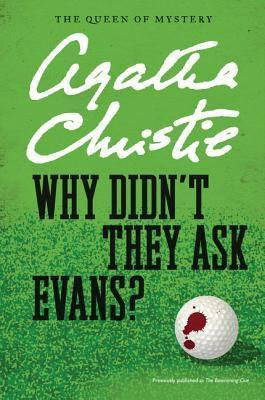
Why Didn't They Ask Evans?
(1934) by Agatha Christie

This is lighter and breezier than most novels by Agatha Christie. The two main characters are Bobby Jones, the vicar's son, and Lady Frances Derwent (Frankie). They were friends in childhood but have drifted apart as they grew older. Bobby discovers a dead body which had fallen off of the cliffs of the Welsh seacoast, and Frankie is convinced it was murder. It was a very entertaining story, once I settled into the tone of the book, and I never had a clue who the murderer was. I read it at this time because we wanted to watch Hugh Laurie's adaptation, and we have now done that. I enjoyed it as much or more than the book.


Status of my challenges and other events:

  • I have read and reviewed four novels for the European Reading Challenge. That leaves only one more to complete my goal of five books, but I hope to read more novels set in European countries.
  • I have read at least six books that fit categories for the Book Bingo Challenge
  • Back to the Classics Challenge: I have read Rebecca by du Maurier, for the "20th century classic." I have read and reviewed Beast in View by Millar, which can be used either for a "classic by a woman author" or for the "Mystery/Detective/Crime classic."
  • The TBR Pile Challenge: Two books that I read this month were for this challenge, Dog On It by Spencer Quinn and Bangkok 8 by John Burdette. 
  • In March and April I read two books for the 1954 Club: Go, Lovely Rose by Jean Potts and Death Likes It Hot by Edgar Box (aka Gore Vidal).


The photo at the top of the post and the one immediately above are from a recent visit to our local plant nursery, the first one this year. My husband took photos of plants, pots, and garden decorations. Click on the images for best viewing quality.


Saturday, January 29, 2022

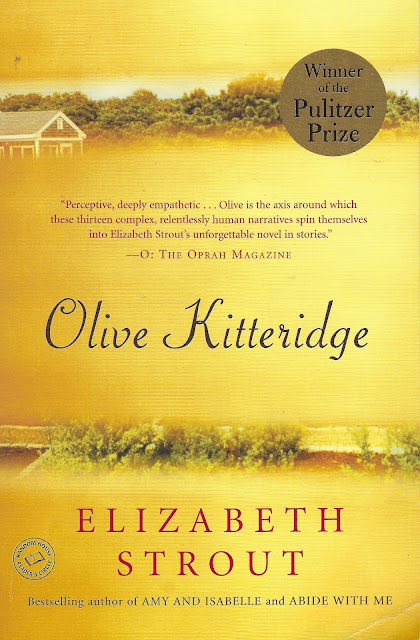
Olive Kitteridge: Elizabeth Strout


This book won the Pulitzer Prize for fiction in 2009, and was described at that site as:

A collection of 13 short stories set in small-town Maine that packs a cumulative emotional wallop, bound together by polished prose and by Olive, the title character, blunt, flawed and fascinating.


Olive Kitteridge is the focus for many of the stories. Within the confines of her family, Olive's behavior can be very volatile and damaging. She is a controlling mother to her son Christopher and somewhat abusive. In her life outside the home she has a reputation for being disagreeable and prickly. Yet at times she can be helpful and kind to friends and neighbors.

The first story, "Pharmacy," focuses on Henry, Olive's husband, and is told from his point of view. Of course it tells us a lot about Olive, their marriage, and some about Christopher, their son. That story is a fantastic opener for the book. Henry is a genuinely good, considerate, generous man, who tries to think the best of all people at all times. From what we know of Henry in the stories in this book, he is this way with everyone: with his family and the customers he meets at his pharmacy and neighbors in the community. He also tries to mediate between his son and Olive.

There are only four or five stories (out of thirteen) that focus primarily on Olive and her thoughts and reactions to people. The other stories focus on incidents experienced by families within the community of Crosby, Maine. Each story contains at least one appearance or mention of Olive. Sometimes the story is not about her but she takes an active part. 

The other stories provide other viewpoints of Olive and her behavior. Those stories are still good, just not my favorites. And some of the stories were distressing to read. The stories cover Olive and Henry's life together and spans  decades of their lives, but most of them are about the later years. 


My thoughts:

The stories in this book provide an interesting picture of small town life in Maine. The emphasis was on people that have particularly problematic lives and relationships, and I am sure that communities like this one have many "normal" families also. Some stories related to old age, life after losing a spouse, and suicide.

I found most of the stories to be depressing. I am sure that this is not true for every reader, but it was true for me. Several of the stories were about damaged families with children who were affected by the situation. There we some rays of light, some people who escaped from their situation and were looking for a better life for them. Most nights I read only one story from this book, and had to stop for the night. Yet I liked the book quite a lot. Olive is a wonderful character regardless of her flaws. I was never bored. 

The last two stories that were primarily about Olive were exceptional. In "Security," Olive visits her son and his new family; it was emotional, unsettling at times, but not so depressing. "River" ended on a positive note. 

I will read Olive, Again, the second book of stories about Olive Kitteridge, and I will read more books by this author. I have My Name is Lucy Barton on my TBR. Elizabeth Strout is a fantastic writer and had me sympathizing or empathizing with many of the characters.


 -----------------------------

Publisher:  Random House, 2008
Length:     270 pages
Format:    Trade paperback
Series:     Olive Kitteridge
Setting:    Small town in Maine
Genre:     Fiction
Source:    I purchased my copy