Showing posts with label Science Fiction. Show all posts

Tuesday, June 23, 2026

The City in the Middle of the Night: Charlie Jane Anders

My son read this book first. He liked it, with reservations. (More about that later.) The subject interested me, so I decided to read it also. It is science fiction, about life on a colonized planet, where half of the planet is perpetually cold and in the dark, and the other half is always in the light and hot. 

This summary is from the back of the edition I read:

Humanity clings to life on January–a colonized planet divided between permanently frozen darkness on one side, and blazing endless sunshine on the other.

Two cities, built long ago in the meager temperate zone, serve as the last bastions of civilization–but life inside them is just as dangerous as the uninhabitable wastelands outside.

Sophie, a young student from the wrong side of Xiosphant city, is exiled into the dark after being part of a failed revolution. But she survives–with the help of a mysterious savior from beneath the ice.


The story takes place thousands of years in the future. The planet of January was populated by humans from earth and many nations worked together to create the ship that carried the people to January. The cooperation between the nations was not entirely successful (not surprising) and resulted in problems in setting up the cities for the settlers. There are two point of view characters: Sophie and Mouth. Sophie's sections are told in 1st person narrative; Mouth's sections are in third person. 

Sophie is the primary character in the book. She and Bianca are students in a school in Xiosphant city, but Sophie is lower class and won her place at the school with her intelligence. Bianca is from a rich family and is spoiled and manipulative; they are close friends, and Sophie has a strong attachment to Bianca.

Mouth is the last surviving member of a nomadic group called the Citizens, and was traumatized by losing her community at such a very young age. She feels like it is her duty to preserve their heritage. These things drive a lot of her behavior and decisions. When the story opens, Mouth is traveling with another nomadic group named the Resourceful Couriers, who carry contraband between the two major cities.


My thoughts:

  • Overall, this was a good read. The pace was good, the story was good. It took me a good while to warm up to Mouth. Many of the characters were flawed, which is to be expected, but Sophie had a good heart to the end, so I hung on to find out how she weathered the vicissitudes she suffered. She and Mouth sort of balanced each other out.
  • There were so many characters (besides the three I have mentioned), and most of them were interesting, with their own agendas and flaws, but it was hard to keep track of all of them. And I could have used a map.
  • I think the book was too long although it was hard to say what could have been left out. The book was only 360 pages but I would have liked it to be closer to 300. But, this book has stuck in my mind since I finished it a month ago, and most books don't do that.
  • The story goes in a weird direction in the last 80 pages. Very weird, and it would be too much of a spoiler to talk about it here. There are hints of this ending as the story progresses, but still I was very surprised. I liked the turn of events and I liked the way it was handled.


I asked my son what his one sentence review of The City in the Middle of the Night would be. He said it was "a well written book that doesn't quite know what it wants to be." He also thought it was longer than it should be.


Tuesday, September 30, 2025

Annual Book Sale 2025: My Son's Books

As usual, we attended the Planned Parenthood Book Sale that runs for 10 days in September; the first few days and the last few days are the busiest; we went five times this year. 

My son's tastes usually are in the fantasy or science fiction genres. Below are a few of the books that my son purchased this year.


Can't Spell Treason Without Tea by Rebecca Thorne

Originally published in 2022; this trade paperback edition was published in 2024.

This is a cozy fantasy about a lesbian couple who want to leave their current lives behind and open a bookstore in a remote location where no one can find them. The problem is that one of them is a private guard to a powerful and cruel queen, and the other is an important and powerful mage. 

Note: I just finished reading this book and I enjoyed it a lot. It seemed to me to go just a bit beyond the bounds of cozy, but that was fine with me.


Dinotopia Lost by Alan Dean Foster


Dinotopia is a fictional utopia created originally by James Gurney in 1992. In the first book, Dinotopia: A Land Apart from Time, which had illustrations, Arthur Denison and his son, Will, are shipwrecked on island where humans and dinosaurs live together in harmony. James Gurney wrote three more books about Dinotopia, but other authors have also written spin-off books in the series. In Alan Dean Foster's Dinotopia Lost, published in 1996, a ship with a crew of pirates lands on the island.


Monday Starts on Saturday by Arkady and Boris Strugatsky, Andrew Bromfield (Translation)


This book was first published in 1965 and seems to be a combination of science fiction and fantasy. Humorous and satirical.

This description is from a summary at Goodreads

Sasha, a young computer programmer from Leningrad, is driving north to meet some friends for a nature vacation. He picks up a couple of hitchhikers, who persuade him to take a job at the National Institute for the Technology of Witchcraft and Thaumaturgy. The adventures Sasha has in the largely dysfunctional Institute involve all sorts of magical beings—a wish-granting fish, a tree mermaid, a cat who can remember only the beginnings of stories, a dream-interpreting sofa, a motorcycle that can zoom into the imagined future, a lazy dog-size mosquito—along with a variety of wizards (including Merlin), vampires, and officers. 


The Protectorate Series by Megan E. O'Keefe

This series is a space opera trilogy, that begins with Velocity Weapon (published in 2019, 544 pages) and continues the story with Chaos Vector (published in 2020, 546 pages) and Catalyst Gate (published in 2021, 608 pages). The 1st book sounds very good, and I have read good reviews of the 2nd and 3rd books. 


This excerpt from the review at Kirkus is the best description of the first book in the series that I could find.

The last thing Sanda Greeve remembers is her ship being attacked by rebel forces. She's resuscitated from her evacuation pod missing half a leg—and two centuries—as explained to her by the AI of the rebel ship that rescued her. As The Light of Berossus—aka Bero—tells her, she may be the only living human for light-years around, as the war wiped both sides out long ago. Sanda struggles to process her injuries and her grief but finds friendship with the lonely spaceship itself. Sanda's story is interspersed with flashbacks to the war's effects on her brother, Biran, as well as scenes from a heist gone terribly wrong for small-time criminal Jules. The three narratives, separated by a vast gulf of time, are more intertwined than is immediately apparent. When Sanda rescues Tomas, another unlikely survivor, from his own evacuation pod, she learns that even time doesn't end all wars. Should she trust Tomas, a fellow human but a rebel soldier who has his own secrets—or Bero, the ship that saved her?


                            Velocity Weapon


                              Chaos Vector


                                Catalyst Gate


Tuesday, September 16, 2025

Short Story Wednesday: Collections from the Book Sale


Last Friday, September 12, was the first day of the Planned Parenthood Book Sale; it will continue through Sunday, September 21. We went to the book sale on both Friday and Saturday. (And we will go back again tomorrow, and Saturday and Sunday.) 

Every year I plan to limit my short story book purchases at the sale, since I have so many already, both in print editions and on the Kindle. Yet I was unable to resist the four books I am featuring here.


The Complete Stories, Volume 1

Isaac Asimov

This book consists of the stories previously collected in Earth Is Room Enough (1957), Nine Tomorrows (1959), and Nightfall and Other Stories (1969). There are a total of 48 stories by Asimov in this volume. Asimov wrote short stories in other genres, but my impression is that this volume is primarily science fiction and fantasy tales. 


I, Robot

Isaac Asimov

This is a book I have planned to read for years. It consists of nine short stories, which originally appeared in science-fiction magazines in the 1940's. Recently, Kelly at Kelly's Thoughts & Ramblings read and reviewed I, Robot. She enjoyed the book and that motivated me to read it sooner rather than later.


The Truth and Other Stories

Stanisław Lem; Antonia Lloyd-Jones (Translator); Kim Stanley Robinson (Foreword)

Stanisław Lem (1921-2006) was a Polish writer. I don't know much about his writing, except that he was best know for his science fiction novels and short stories. His most well-known novel was Solaris (1961). This book of 12 science fiction short stories was published in 2021 and includes 9 stories that previously had not been published in English.


Lake of Souls: the Collected Short Fiction

Ann Leckie

I took a chance on this book because I am interested in Ancillary Justice, the first book in her Imperial Radch series. This collection has seven stories from the Universe of The Raven Tower, a standalone novel, three stories from the Imperial Radch Universe, and eight unrelated stories. 


Tuesday, September 2, 2025

Short Story Wednesday: Jewel Box by E. Lily Yu


Today I read the first four stories in Jewel Box, a short story collection by E. Lily Yu. I bought the book on a whim at the Planned Parenthood book sale last year, and I was probably influenced by the lovely and unusual cover. 

Although I have only read four of the stories, the ones that I read have an unreal, fairy tale quality. 


The first story is "The Pilgrim and the Angel," which tells the story Mr. Fareed Halawani, the operator of a coffee shop in Cairo, who misses his son, who is living in Miami, and worries that he does not call home and talk to him and his mother. He is visited by an angel who plans to take him on hajj, but he persuades the angel to take him to Miami to see his son instead. It has a lovely ending, but also a sad one. 

The second story, "The Lamp at the Turning," is my favorite so far. A simple story of a street lamp who turns on only when a certain young man walks by twice a day (on the way to work?). The street lamp loves the young man and is resentful of the young woman who begins to accompany him on his walks.

"The Cartographer Wasps and the Anarchist Bees" is the most well-known of Yu's stories; in 2012 it was nominated for the Hugo, Nebula, Locus, and World Fantasy Awards. I read that story in an anthology a few years ago, and I read it again twice in this collection. It is a wonderfully inventive story, but I confess to having problems understanding the story during all three reads. The ideas and symbolism were too much for me. 

“The Lion God and the Two Gates,” is an interesting story of a judge who prides himself on his neutrality and fairness; the Lion God of the title presents him with a decision to make about his fate after his death.


My highest praise is for Yu's wonderful writing style. I enjoyed reading the stories even when I was a bit confused. The collection has 22 stories and I will eventually read them all.


Saturday, August 9, 2025

Ninefox Gambit: Yoon Ha Lee

Ninefox Gambit by Yoon Ha Lee is the first book in the Machineries of Empire trilogy. This is the summary of the book at the author's website:

Kel Cheris, a disgraced captain of the hexarchate, is given the opportunity to redeem herself by recapturing the formidable Fortress of Scattered Needles from heretics. Cheris requests—and receives—a single devastating weapon to aid her in her task: the revived, near-immortal traitor, General Shuos Jedao. Feared throughout the stars and undefeated in battle, he is the perfect weapon. But Jedao is gripped by a madness that saw him massacre two armies in his first life—one of them his own. Preserved for his brilliance and tamed by his handlers, no one knows how long his good behaviour will last. Cheris must work with the mass murderer to destroy the heresy and save the hexarchate—before he destroys her…

A tale of math, madness, and massacres in outer space.


My Thoughts:

This is a science fiction book and specifically a military space opera. In many ways, it feels as much like fantasy as science fiction. Here the reader is dropped into a universe where the scientific laws that govern the universe are based on a "calendrical" mathematics system that seems more like magic. There are groups of heretics who refuse to follow the accepted mathematics systems. However, there is no attempt to explain all of this to the reader. For at least the first third of this book I had no idea what was going on.

On top of that, there were no characters that I cared about or could invest in. 

At the point that I was about to give up on the book, I read a review that called this book "brain-breaking" but also said to just hang in there and it would be worth it. That reviewer was right and it was worth reading. I finally caught onto the general idea of what was going on, and was hoping that the author was going to give me a satisfactory ending. And I did get it. I was invested in the two main characters; the ending was amazing. That is good, because I already have a copy of the second book in this series, Raven Strategy


So, if you like science fiction, you might want to try this series, or at least read a few reviews of the book to get other opinions.


Additional notes:

I have read military science fiction before; John Scalzi's Old Man's War series is an example. But those stories are remarkably easy to read compared to this one. 

Apparently there are a lot of science fiction books / series that start out like this series, throwing the reader into an imaginary setting with little explanation. Readers are divided on whether they like that or not. And now I can think of mystery novels (with sort of a science fiction or fantasy flavor) that are this way too. For example, The 7½ Deaths of Evelyn Hardcastle by Stuart Turton.


 -----------------------------

Publisher:   Solaris Books, 2016
Length:      384 pages
Format:      Trade paperback
Series:       Machineries of Empire, #1
Setting:      Outer Space
Genre:       Science Fiction 
Source:      On my TBR since 2020.

Wednesday, March 19, 2025

Diving into the Wreck: Kristine Kathryn Rusch


This book is in the science fiction genre, and the diving referred to in the title is diving into wrecked space ships, not ships at the bottom of an ocean. Which might be obvious if you can get a close enough look at the cover. My son loaned me this book and encouraged me to read it, and I am so glad that he did.


The protagonist in this story is a woman who makes her living diving into derelict ships out in space. She is always referred to as Boss. No other name is ever given. She is a loner; she knows a lots of people who work in the same business as she does, and she works with crew members who have skills in diving or technology. But she seems to have no real friends. Boss has had a hard life and has developed a hard shell over her emotions because of it.

Sometimes she goes on salvage operations to bring in some money, but her real love is history and she likes to study the ships. She also takes out groups of tourists to give them the experience of wreck diving in space. One day, when Boss is returning from a salvage mission, she sees a blip on her ship's sensors that leads to a strange ship – a ship that is obviously ancient and possibly very, very dangerous. 

The book is divided into three parts. In the first part, Boss hires a crew to dive into the ancient ship and find out what is there. She has suspicions that this is a ship that came from earth and could be dangerous, but she does not tell her crew this. She wanted to get verification from them without prejudicing them beforehand. However, once they arrive at the abandoned ship, some of the crew are angry that they were not warned, and one woman, Squishy, is scared so badly that she wants them to abandon the dive and return home. During one of the dives, a crew member has to be abandoned in the ship. That incident is the beginning of more adventures related to the ancient ship. 


My thoughts:

I liked the writing style. It was spare, and there was a lot of dialog at times. But the pace was good and it kept me interested. The first two parts of the book were first published as novellas previously but changes were made for this publication. Each of the three parts is about a separate expedition (although they all tie in to the discovery of the ancient ship); for me the transitions between the three parts worked well. And I liked that I could stop easily between each one. 

The characterization is good, but since the story is first person narration from Boss's point of view, we only know what she thinks and feels. Several of the secondary characters that work on Boss's crews are portrayed in depth; there is a good depiction of an old cynical military man later in the story. 

The world building is done well. The story is set far into the future, in the Enterran Empire. The planet Boss lives on is Hector Prime, which is on the edge of the empire, near the Nine Planets Alliance. Boss is a citizen of the Enterran Empire, but her sympathies lie with the Nine Planets Alliance. Beyond that there is not a lot of dwelling on the science involved. Other reviewers who are more in the know than I am about science fiction say that this is a novel that people who are new to science fiction can enjoy. 


There are 18 books in this series at this point and I plan to look for more of them to read.

Please see another review at Carl's blog, Stainless Steel Droppings. Carl was the original host for the Readers Imbibing Peril Challenge (and also the Science Fiction Experience Challenge and the Once Upon a Time Challenge).


Friday, January 3, 2025

Six Degrees of Separation: From Orbital to Station Eternity


The Six Degrees of Separation meme is hosted by Kate at booksaremyfavoriteandbest. The idea behind the meme is to start with a book and use common points between two books to end up with links to six books, forming a chain. The common points may be obvious, like a word in the title or a shared theme, or more personal. Every month Kate provides the title of a book as the starting point.


The starting book this month is Orbital by Samantha Harvey. For once, I have actually read the book. It depicts one day in the life of six astronauts on the International Space Station, watching the sunrises and sunsets and monitoring a typhoon threatening inhabited islands. The reader is privy to their thoughts, and watches their activities and their regimen.

Reading Orbital motivated me to read more about life on the International Space Station. I want to know how astronauts are selected for this type of mission and how they train for it.  I don't even like to fly in an airplane (of any size) but I would love to know more about the lives of people who live in the space station.

1st degree:

My first book is from my husband's shelves: Lonely Planet's The Universe. This book has a wealth of information about Earth and the other planets, and other parts of the known universe. Photos on every page. There are smaller sections on the manned space flights and the International Space Station. A lovely book to dip into now and then.

2nd degree:

I am sticking with the space station theme throughout, and my next book is Endurance: My Year in Space, A Lifetime of Discovery, by Scott Kelly with Margaret Lazarus Dean, a memoir published in 2017. Per his website: "A veteran of four space flights, Kelly commanded the International Space Station (ISS) on three expeditions and was a member of the yearlong mission to the ISS." 

I have purchased a copy of this book to read sometime this year. 

3rd degree:

My next link is a short story, "Stranger Station" by Damon Knight, which I read in Bug-Eyed Monsters, edited by Bill Pronzini and Barry N. Malzberg. The story is about a race of aliens that were so massive and repulsive to humans that the contact has been sparse and only occasionally do the aliens visit a space station that is set aside especially to enable that visit. When one of the aliens comes, it is for one purpose, to provide a substance for the humans which the humans have come to rely on. The story focuses on the one human who is on the space station to facilitate the exchange with the alien being. He is alone on Stranger Station until the alien arrives, although he can communicate with a computer AI called "Aunt Jane." 

"Stranger Station" was first published in The Magazine of Fantasy and Science Fiction, December 1956, but has been included in a good number of anthologies since then.

4th degree:

Since reading Orbital, I have been looking for fiction set on a space station, and I found that my son has several books that fit that category. This is one he read: Diving into the Wreck by Kristine Kathlyn Rusch. The heroine of the book explores derelict space vehicles, sometimes for salvage, sometimes as a historian. The book consists of three connected novellas and at least one of them is about The Room of Lost Souls, which is an abandoned space station which most people consider a myth.  It sounds great and I will be reading this book.

5th degree:

The fifth link in my chain is to The Burning Dark by Adam Christopher. From the description on the back of the book:

Back in the day, Captain Abraham Idaho Cleveland had led the Fleet into battle against an implacable machine intelligence capable of devouring entire worlds. But after saving a planet, and getting a bum robot knee in the process, he finds himself relegated to one of the most remote backwaters in Fleetspace to oversee the decommissioning of a semi-deserted space station well past its use-by date.

This one sounds good too, so I will add it to my TBR list.

6th degree:

My sixth book is a genre blend of mystery and science fiction: Station Eternity by Mur Lafferty, first published in October 2022. 

From the back of the book:

From idyllic small towns to claustrophobic urban landscapes, Mallory Viridian is constantly embroiled in murder cases that only she has the insight to solve. But outside of a classic mystery novel, being surrounded by death doesn’t make you a charming amateur detective, it makes you a suspect and a social pariah. So when Mallory gets the opportunity to take refuge on a sentient space station, she thinks she has the solution. Surely the murders will stop if her only company is alien beings. At first her new existence is peacefully quiet…and markedly devoid of homicide.

Unfortunately for Mallory, that doesn't last very long. I love mystery and science fiction mixed, so I will probably read this one too.


My Six Degrees started in space and it stayed mostly in space. It started with a novel about our International Space Station, but took me to science fiction worlds set in the future. It also added four books to my "To Read" list.


The next Six Degrees will be on February 1st, 2025 and the starting book will be a classic – Dangerous Liaisons by Pierre Choderlos de Laclos.


Sunday, April 28, 2024

The Humans: Matt Haig


I enjoyed reading this book so much. It brightened my life, it improved my mood, it helped me to feel more love and acceptance for others. And it almost certainly will be one of my top ten books of 2024.

I am going to use a paragraph from the beginning of the novel to describe this book: 

This book, this actual book, is set right here, on Earth. It is about the meaning of life and nothing at all. It is about what it takes to kill somebody, and save them. It is about love and dead poets and wholenut peanut butter. It’s about matter and antimatter, everything and nothing, hope and hate. It’s about a forty-one-year-old female historian called Isobel and her fifteen-year-old son called Gulliver and the cleverest mathematician in the world. It is, in short, about how to become a human.

This book is a science fiction story, but for me, it felt like a book about how to live a better life, a sort of self help book. Or possibly a book about a philosophy of life. 


The protagonist of this book is an unnamed alien, a Vonnadorian. He has been sent to earth because an earthling, Andrew Martin, has discovered the solution to the Riemann hypothesis. The Vonnadorians have determined that this discovery will lead to technical development on earth that humans are not ready for and they want it stopped, no matter what it takes. 

The alien takes over Andrew's body. His mission is to kill anyone that knows about Andrew's work and is aware that he had successfully come up with a solution. That includes Andrew's wife and 16-year-old son. 

The only real science fiction elements in this book are that the alien has powers (for example, he is much stronger than normal humans and can heal humans and animals) and he gets communications from his superiors back on his own planet. Otherwise, the focus is on how he learns to fit into human society with no real instructions, so that he can accomplish his goal. He makes a lot of mistakes along the way.

The alien in Andrew's body starts to have misgivings about his mission. Initially he finds humans disgusting, but once he can stomach living with humans and interacting with them, he begins to like some of them. The family has a dog, and the dog knows that this being is no longer really Andrew, but the alien develops an affection for the dog and vice versa. As Andrew, he tries to interact with the teenage son, who despises his father. 

The alien reads a lot (starting with Cosmopolitan, which gives him some strange ideas) to try to learn about humans. The poet he especially likes is Emily Dickenson. He cannot stand human food, but he does like peanut butter sandwiches, and that is mainly what he subsists on. Since I also eat a lot of peanut butter, I considered this a plus.

The story is narrated by the alien and seems to be a book he is writing for Vonnadorians, to explain his actions after he arrived on earth. It is often humorous but sometimes dark.


---------------------------------------------

Publisher:   Simon & Schuster, 2013
Length:       285 pages
Format:       Hardcover
Setting:       Earth, UK
Genre:        Science fiction
Source:       On my TBR since 2020.


Tuesday, March 19, 2024

Short Story Wednesday: "Forgiveness Day" by Ursula K. Le Guin


"Forgiveness Day" by Ursula K. Le Guin is a science fiction novella published in 1994, a part of Le Guin's Hainish cycle of books. I have not read any of the Hainish novels and I am not sure how much my unfamiliarity with those stories affected my reaction to this story. However, in retrospect I don't think that was the problem. 

First paragraph:

Solly had been a space brat, a Mobile's child, living on this ship and that, this world and that; she'd traveled five hundred light-years by the time she was ten. At twenty-five she had been through a revolution on Alterra, learned aiji on Terra and farthinking from an old hilfer on Rokanan, breezed through the Schools on Hain, and survived an assignment as Observer in murderous, dying Kheakh, skipping another half millennium at near-lightspeed in the process. She was young, but she'd been around. 

The story describes Solly's experiences as the first Envoy of the Ekumen to the Divine Kingdom of Gatay. The themes of the story seem to be feminism, misogyny, sexual repression, and slavery.

Solly is assigned a Guide and a Guard, plus a Maid. At least one of those three were with her at all times. The Maid was assigned to her as an asset, which was essentially the same as a slave, which Solly was very uncomfortable with. Women did not take part in any events that Solly attended. Solly is treated as an equal to the males in the society, to a certain extent, but it is clear that they all look down on her. She never has any contact or conversations with women, because they all wait at home for their husbands. Solly and the Guard, Rega Teyeo, have an antagonistic relationship, which is explained to some extent by revealing his very complex backstory.

She gets around her isolation to a certain extent by gaining access to Batikam the Makil. He is a transvestite, part of a traveling troupe of entertainers, and is allowed to visit her at night after his performances.

During Forgiveness Day activities, Solly and the Guard are taken prisoner by a rebel group. Up to that point they have never spoken more than necessary, but they are forced to get to know each other under the circumstances.


The first half (or more) of the story was very complex and confusing for me. I suspect I read it too fast. I went back and reread bits of it and figured out where I had gone astray, and I intend to read it again in full.

I was emotionally engaged and moved by the ending of the story, and when that happens, I figure that the author has succeeded. So my final "rating" for this story is very high.


I read this story in The Year's Best Science Fiction, Twelfth Annual Collection, edited by Gardner Dozois. All the stories in that anthology were published in 1994.

It is also included in Five Ways to Forgiveness, an eBook published by Library of America, which includes five stories (one novelette and 4 novellas) in the Hainish cycle.

Two other short stories I have read by Le Guin are "The Shobie's Story" (also in the Hainish cycle) and "The Ones Who Walk Away from Omelas", reviewed at the Casual Debris blog in September 2023.


Tuesday, November 7, 2023

Short Story Wednesday: Larry Niven's Known Space


Recently my son told me about Larry Niven's Known Space stories and novels. The books he has are two spin-off Man-Kzin Wars anthologies. The first book, The Man-Kzin Wars, began with an early story by Larry Niven, "The Warriors," and includes two novellas by other authors.


I then looked into overviews of the tales of Known Space. I purchased ebook copies of Three Books of Known Space and Neutron Star. Three Books of Known Space has a number of short stories plus two novels, Worlds of Ptavvs and A Gift from Earth. Neutron Star is a short story collection. 


These are the stories I have read from those books:

"The Coldest Place" (in Three Books of Known Space)

This was Niven's first published short story; it first appeared in Worlds of If, December 1964.

There are two characters, Eric and Howie. Eric had a terrible accident; his brain and spinal cord was saved and integrated into a spaceship. He and Howie travel together on missions. When they are in space, they are mutually dependent for their survival. On this trip they are visiting Mercury.

"Becalmed in Hell" (in Three Books of Known Space)

This story also features Eric and Howie. On this trip they visit Venus. I liked both stories about Eric and Howie; they are entertaining and humorous.

"The Warriors"  (in Three Books of Known Space and The Man-Kzin Wars)

This was the first story that Niven offered for publication but it wasn't accepted for publication until 1966. It was also the first encounter between humans and the kzinti. According to the larryniven.net site: "Kzin are larger than Humans, a large male Kzin may be eight feet tall and weigh nearly 500 pounds. They are bipeds, standing erect on short legs. They have bright orange fur with individualized black markings, which most commonly appear on the face and hands. They are powerfully built, with thick limbs and torso." Per Niven's introduction to The Man-Kzin Wars, the kzinti in "The Warriors" are not so well defined at that point.

This one was also a very good story. The kzinti in a spaceship see an alien ship in the distance; a kzin telepath determines where they are going, etc. The kzin Captain wants to kill all the people on board the alien ship, then find out what world they come from, and take it over. The alien ship's crew are humans from Earth on a colony ship heading to the planet We Made It.

"Neutron Star" (in the Neutron Star short story collection)

This story was very full of science facts (and fiction) that almost overwhelmed me. Maybe my brain hasn't recovered from the time change yet. But it was a good read and entertaining. A pilot in need of a job takes on a mission to go to a neutron star and figure out why the previous mission failed. This story starts out on the planet called We Made It.


So, I have questions. Do I need to read more books by Larry Niven before I read novellas from the Man-Kzin Wars spin-off series? Does order matter within the Known Space books? I did find some articles online that address this but the answers vary.


Monday, October 2, 2023

Top Ten Tuesday: My status on my Bookish Goals for 2023


Top Ten Tuesday is a weekly meme hosted by That Artsy Reader Girl. This week the topic is "Reading Goals I Still Want to Accomplish Before the End of the Year." 

I am choosing an alternate option, to report on how I have done on my Bookish Goals for 2023, which I shared in more detail last January on my blog. After each goal, I am adding a brief note about my status as of the end of September.


1. Read more graphic novels.  I was aiming for one a month.

Current Status:  I read a total of five so far: two graphic memoirs in August, and three books in the A Man and His Cat series (Japanese manga). This is an improvement over last year.


2. Read more science fiction. My aim in 2023 was to read ten novels or short story anthologies.

Current Status: I did not do very well in this area. I read two science fictions novels (one by John Scalzi, the other an alternate history book). And a few short stories. Next year I would change this goal to also include fantasy novels. 


3. Read more espionage novels. My goal was to read 10 or 12. Specific authors I would like to catch up on are Anthony Price, Victor Canning, Len Deighton, Mick Herron, and Charles Cumming.

Current Status: I have only read six spy fiction novels in 2023 so far. I read novels by Anthony Price, Victor Canning, and Mick Herron, but haven't read any by Len Deighton or Charles Cumming.


4. Aim at reading books on my shelves rather than buying new books. 

Current Status: I did very well on reading books from my own shelves. My goal for 2023 is 48 books, and I am only one shy of that at this point. But I have not succeeded at all on cutting back on buying new (to me) books.


5. Read more ebooks. I continue to buy ebooks but hardly ever read them. 

Current Status: Total Failure. I have read one ebook this year.


6. Read some every morning. Anything would be fine, but I can't read ebooks at night because it interferes with my sleep, so ebooks would be a priority. 

Current Status: Not much progress on this one either. I sometimes read in the morning or afternoon, but only now and then.


7. Read more books from my Classics List. My goal was to read at least one classic a month. 

Current Status: I think I only read five books from my classics list this year. I am far behind on completing my Classics List.


8. Train myself to write short reviews. I don't necessarily want to write only brief reviews, but I would like to master that art.

Current Status: I did make some efforts in this area, but with little results. However, it is still an important goal for me.


9. Complete more short story anthologies or collections. I currently have many half-finished short story books all over the house. 

Current Status: My goal was to complete one short story book a month. On a quick glance through the blog, I think I finished 5 collections or anthologies so far this year. That is not bad, but I may have to accept that I just don't like that approach to reading short stories; usually I just want to dip in and out of short story anthologies or collections.


10. I want to regularly track my goals and any challenges I participate in. 

Current Status: I knew that would be a real challenge for me, and I haven't kept up with it. I have to decide how much I care about this, and whether it is worthwhile for me.


Summing up

To be honest, I don't know that I am going to push to finish any of my current goals in the last three months of the year. In the summer months, I read a lot of books from my TBR shelves for the 20 Books of Summer (all of which I enjoyed), and now I am more interested in just reading what strikes my fancy for the rest of the year. Between now and the end of the year, I plan to read two books for the 1962 Club in October and I hope to read some books with Christmas themes in December.

However, this has given me a great opportunity to think about what Bookish Goals I want to aim at in 2024.


Tuesday, July 25, 2023

Short Story Wednesday: Science Fiction Stories from 1990

These were not the short stories I was planning to read this week. But then my next door neighbor had a yard sale and I bought four anthologies from the Year's Best Science Fiction series, edited by Gardner Dozois. The one I decided to start reading was The Year's Best Science Fiction: Eighth Annual Collection.


I only read the first three stories, but that still totaled nearly 100 pages. The first story was a novella at about 53 pages and the other two were novelettes. I found all of them challenging and a bit overwhelming in one way or another. 


"Mr. Boy" by James Patrick Kelly

I had not heard of James Patrick Kelly before reading this novella about a 25-year-old man whose growth has been stunted by genetic manipulations, so that he remains in the body of 12-year-old boy. His mother purchased this modification for him, and the story is at least partly about the misuse of wealth. In this society these types of body modifications are not unusual and are carried to many extremes. I found the first half very weird but the second half was much better. The story was told in first person narrative by Mr. Boy.

In 1994, Kelly published a novel, Wildlife, that was a fix-up of this story and at least one other story featuring some of the same characters. I would be willing to give it a try someday.


"The Shobies' Story" by Ursula K. Le Guin

This story is set in a universe in which the ability to travel to another destination can be done instantaneously.  A group of people have volunteered to be the first humans to try this type of travel and see what effects it has on them, mentally and physically. The crew come from various planets and have various skills; some children are included. They first gather for a bonding experience before the flight.

The story is a part of the Hainish Cycle by Le Guin, but I have not read any of her science fiction writing, so I had no experience with that.  

I had an exceptionally hard time with this story and I had to read it twice to get any grip on it at all. I liked the first half but it went downhill in the second half. 


"The Caress" by Greg Egan

Another author I had not heard of previously. In the introduction to this story, Egan is described as a "hot new Australian writer."

This one is closer to my usual reading, sort of a police procedural set in the future. The protagonist is a policeman but he is enhanced. Policemen are trained from an early age, given drugs to prime their ability to deal with crime (while on the job), and their bodies are enhanced for strength and agility. The crime that is discovered is very strange. A woman of about 50 is found dead, her throat slit, in the living room of her house. In the basement downstairs, the policeman finds a chimera, a leopard's body with a woman's head. The chimera is in a coma. The dead woman turns out to be a scientist who created the chimera.

This was a strange story, very complex, with a lot of scientific explanations. But it was also very interesting, and I liked that it was told in first person, by the policeman.

There are two stories by Greg Egan in this anthology.


So I have 22 more stories and about 515 more pages to read in this collection. There are two more novellas in the anthology; one of them is "The Hemingway Hoax" by Joe Haldeman, about 80 pages long, which won both a Hugo Award and a Nebula Award for Best Novella in 1991.

A bonus: The painting on the cover is Sentinels by Michael Whelan.


Tuesday, February 14, 2023

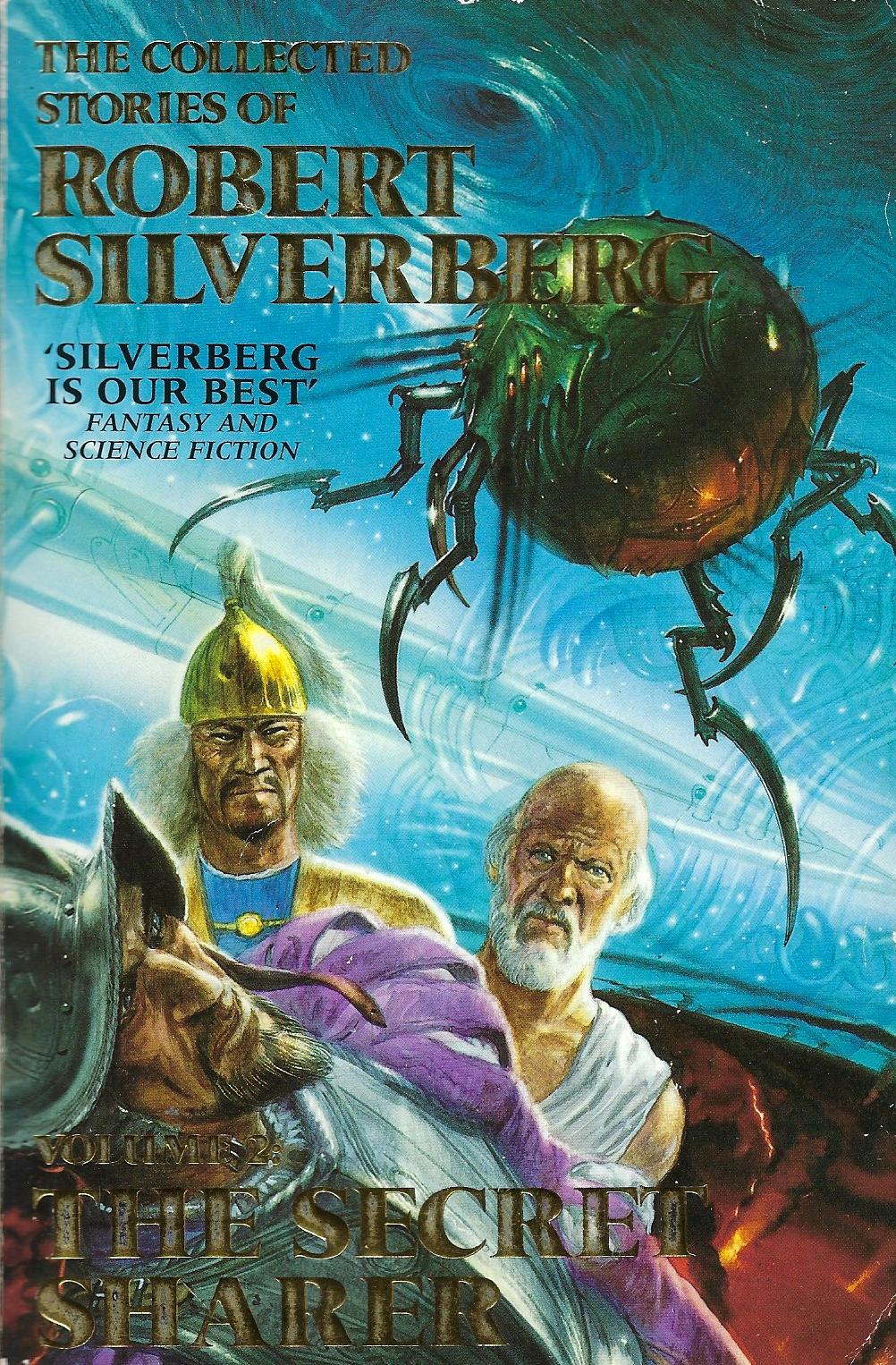
Short Story Wednesday: The Collected Stories of Robert Silverberg, Volume 2

I have just started reading The Collected Stories of Robert Silverberg: Volume 2: The Secret Sharer, first published in 1993.

I have read books or short stories by Robert Silverberg in the past, probably in my early twenties and probably mostly short stories. I know he has a very good reputation as a writer of science fiction and has written a lot of books. The Science Fiction and Fantasy Writers of America made him its 21st SFWA Grand Master in 2005.


This collection has a very good Introduction by Robert Silverberg, written in 1990. He discusses how he writes his short stories, and also talks about writing novels vs. short stories. It also has an excellent paragraph about novellas and where they fit between short stories and full-length novels. Of the eleven stories in this collection, two are novella length: "The Secret Sharer" and "We Are For the Dark." 


The only story I have read so far from this book is "The Pardoner's Tale." It is a longish story, 25 pages in this edition. The protagonist is a Hacker, living in the US in a future where aliens, called the Entities, have taken over the world. They use humans as slave labor and control them through computer implants that connect all humans to their computers. 

Only Hackers can fool the computer and get around the country with relative ease. Hacker's support themselves by selling "pardons" to other humans; they alter that person's profile in the main computer to give them an easier work assignment or save them from medical experimentation. Hacker's have to be careful not to do too many pardons and sometimes deliberately "fudge" them up to cover their tracks. So Pardoners don't have a very good reputation. People have to be desperate to use them.

This was an excellent story, told in first person from the Hacker's point of view. I liked the writing and the story held my interest. It whetted my appetite for more writing by Silverberg, either short stories or novels.

There was another element in this story that I enjoyed. The setting was the Los Angeles basin and there were a number of references to other places along the coast, including Santa Barbara and San Francisco. 


An interesting fact: Of the stories in this book, three of them were first published in Playboy magazine, and "The Pardoner's Tale" was one of those. It was first published in 1987.

Each story has a separate introductory paragraph or two by Silverberg, and for "The Pardoner's Tale" he talked about working with Playboy's fiction editor, Alice K. Turner, and changes she had suggested to stories he had submitted. Also very interesting.


If anyone has any favorite novels or story collections by Silverberg, please let me know.


Monday, October 10, 2022

Head On: John Scalzi

This is the second book in a two book cross-genre series with elements of both science fiction and mystery genres. The first book, Lock In (2014), was a science fiction thriller set in the near future. The story begins about 20 years after the world-wide epidemic of a virus which causes Lock In syndrome. Technological breakthroughs have been developed to the point where the victims of the disease can use a robotic device to move around, talk, and function in society while their bodies are lying in a bed elsewhere. 


The main character of the series is Chris Shane. The virus is called Haden’s Syndrome, so the people who have it are referred to as Hadens. The robot body they used to interact in is called a "threep". Chris is from a rich family, with a trust fund, and has multiple threeps. Most people with Haden's Syndrome cannot afford that. 

Head On continues the story of Chris Shane, who developed the syndrome at a very young age, and has never known a different way of life. In this story, Chris is an FBI agent, partnered with Leslie Vann, who is not a Haden. They have been assigned to investigate the death of a male Haden who was killed while playing a professional sport called Hilketa (sounds like a combination of football and soccer, with swords, hammers, and other weapons). The cause of death is unclear. 

The cool part is that Chris is not defined as male or female in the book. I knew that but I had forgotten by the time I read this second book. When I was reading both the first and second books I always thought of the character as a woman. Many other reviewers had viewed Chris as a male character. The story is told in Chris's voice. I think it was amazing that Scalzi was able to write a book without indicating the sex of the character, but telling it from the point of view of that character does help.

I enjoyed this book as much or more than the first book in the series. The first book was strong on the world building of a culture which has adapted to a significant portion of its population having a debilitating disease and given them a way to continue participating meaningfully in society. It also focuses more on how this had affected the main character's family and how families adapt to having a family member with the syndrome. Head On concentrated more on the crime, and the aspects which would make the death of a Haden more difficult to investigate. 

In a sense, this second book stands alone. I read it six years after reading the first book and I settled into it immediately. There was just enough background included to get back into the near future world and I suspect it would also be easy to read for a reader entirely new to the series. 

I think every book that John Scalzi has written, and certainly the ones I have read, have elements that comment on problems in society. He does this in such a way that this commentary does not interfere with the telling of the story or the enjoyment of the story. 

I loved reading Head On. It was a great mystery, although on the thrillerish side, and John Scalzi tells a story well. Now I want to go back and read Lock In again. I just have to dig it out a box somewhere.


 -----------------------------

Publisher:    Tor Books, 2018
Length:        335 pages
Format:        Hardcover
Setting:        USA
Series:         Lock In #2
Genre:         Sci fi thriller
Source:        I purchased this book.


Saturday, October 8, 2022

My Husband's Books from the 2022 Book Sale


In September we went to the annual Planned Parenthood Book Sale.  The sale lasts about 10 days, and we visited the sale on five of those days. This is my third post on books we bought at this year's book sale.

These are a few of the books my husband found at the sale. Mainly, he focuses on photography, architecture, and performing arts; books about history; then fiction (including mysteries and science fiction). 


The Herring in the Library by L.C. Tyler

This is the 3rd book in the Ethelred and Elsie Mystery series. Ethelred Tressider is a mediocre mystery writer and Elsie Thirkettle is his literary agent. It seems to be a humorous, cozy mystery series. Neither my husband nor I have read any books in the series so he gets to give it a try first. Has anyone read any in the series? Does reading in order matter?


The Twelve Lives of Alfred Hitchcock: An Anatomy of the Master of Suspense by Edward White

From the description on the dust jacket flap:

In The Twelve Lives of Alfred Hitchcock, Edward White explores the Hitchcock phenomenon—what defines it, how it was invented, what it reveals about the man at its core, and how its legacy continues to shape our cultural world.

The book’s twelve chapters illuminate different aspects of Hitchcock’s life and work: “The Boy Who Couldn’t Grow Up”; “The Murderer”; “The Auteur”; “The Womanizer”; “The Fat Man”; “The Dandy”; “The Family Man”; “The Voyeur”; “The Entertainer”; “The Pioneer”; “The Londoner”; “The Man of God.” Each of these angles reveals something fundamental about the man he was and the mythological creature he has become, presenting not just the life Hitchcock lived but also the various versions of himself that he projected, and those projected on his behalf.

My husband started reading this book shortly after he purchased it and has now finished it.


Stately Passions: The Scandals of Britain's Great Houses by Jamie Douglas-Home

From the description at Goodreads:

This historical exploration details some of the most notorious scandals to have engulfed the British royal family and aristocracy, capturing not only the events and their era but also the essence of some of the world's greatest and most beautiful private dwellings. From the Hampton Court of Henry VIII to the modern scandals that saw the present Lord Brocket jailed, center stage is given to the British stately homes that have played witness to centuries of aristocratic indiscretion. Whether examining the "Profumo Affair," the call-girl scandal at Cliveden, the affairs of the lesbian Vita Sackville-West and her bisexual husband at Sissinghurst Castle, or the goings-on at Fort Belvedere, the Surrey hideaway where the Prince of Wales conducted his affair with the American divorcee Wallis Simpson, this account provides a fascinating insight into the lives, loves—and morals, dubious though they may be—of some notorious denizens of the aristocratic world.


Metropolis by Philip Kerr

This is the last book in the Bernie Gunther series. Before World War II, Bernie was a policeman in Berlin; then he worked some as a private detective. He served in the military in both World War I and World War II. The first four novels are set  between 1936 and 1949; the fifth book is set in Argentina in 1950. The sixth book, If The Dead Rise Not, takes Bernie back to 1934 Berlin, when the city was chosen as the site for the 1936 Olympics; later, the novel hops to Cuba in 1954. That is as far as I have gotten in the series. 

Metropolis takes Bernie back to Berlin in 1928, the last days of the Weimar Republic shortly before Hitler came to power.

From the description on the dust jacket flap:

Metropolis, completed just before Philip Kerr’s untimely death, is the capstone of a fourteen-book journey through the life of Kerr’s signature character, Bernhard Gunther, a sardonic and wisecracking homicide detective caught up in an increasingly Nazified Berlin police department. In many ways, it is Bernie’s origin story and, as Kerr’s last novel, it is also, alas, his end. 


London 1945: Life in the Debris of War by Maureen Waller

From the description at Goodreads:

A new social history of London, during a crucial year in the city's history, from the acclaimed writer of 1700: Scenes from London Life. London at the outset of war in 1939 was the greatest city in the world, the heart of the British Empire. The defiant capital had always been Hitler's prime target and 1945, the last year of the war, saw the final phase of the battle of London. The Civil Defence could not have succeeded without the spirit, courage, resilience and co-operation of the people. London 1945 describes how a great city coped in crisis, how morale was sustained, shelter provided, food and clothing rationed, and work and entertainment carried on. Then, as the joy of VE Day and VJ Day passed into memory, Londoners faced severe shortages and all the problems of post-war adjustment. Women lost the independence the war had lent them, husbands and wives had to learn to live together again, and children had a lot of catching up to do. The year of victory, 1945, represents an important chapter in London's—and Britain's—long history.


Three Science Fiction Novellas by J.-H. Rosny aîné; 

Translated and Introduced by Daniele Chatelain and George Edgar Slusser

From the description on the dust jacket flap:

Along with Jules Verne and H.G. Wells, J.-H. Rosny aîné was a founding father of science fiction. He was the first writer to conceive, and attempt to narrate, the workings of aliens and alternate life forms. His fascination with evolutionary scenarios, and long historical vistas, from first man to last man, are important precursors to the myriad cosmic epics of modern science fiction. Until now, his work has been virtually unknown and unavailable in the English-speaking world, but it is crucial for our understanding of the genre. Three wonderfully imaginative novellas are included in this volume. "The Xipehuz" is a prehistoric tale in which the human species battles strange geometric alien life forms. "Another World" is the story of a mysterious being who does not live in the same acoustic and temporal world as humans. "The Death of the Earth" is a scientifically uncompromising Last Man story. The book includes an insightful critical introduction that places Rosny's work within the context of evolutionary biology.


Krakatoa: The Day the World Exploded: August 27, 1883 by Simon Winchester

From the description on the dust jacket flap:

The bestselling author of The Professor and the Madman and The Map That Changed the World examines the enduring and world-changing effects of the catastrophic eruption off the coast of Java of the earth's most dangerous volcano—Krakatoa.

The legendary annihilation in 1883 of the volcano-island of Krakatoa—the name has since become a byword for a cataclysmic disaster—was followed by an immense tsunami that killed nearly forty thousand people. Beyond the purely physical horrors of an event that has only very recently been properly understood, the eruption changed the world in more ways than could possibly be imagined. Dust swirled round the planet for years, causing temperatures to plummet and sunsets to turn vivid with lurid and unsettling displays of light. The effects of the immense waves were felt as far away as France. Barometers in Bogotá and Washington, D.C., went haywire. Bodies were washed up in Zanzibar. The sound of the island's destruction was heard in Australia and India and on islands thousands of miles away. 

Cath read and enjoyed this book. She reviewed it at her blog, Read-Warbler


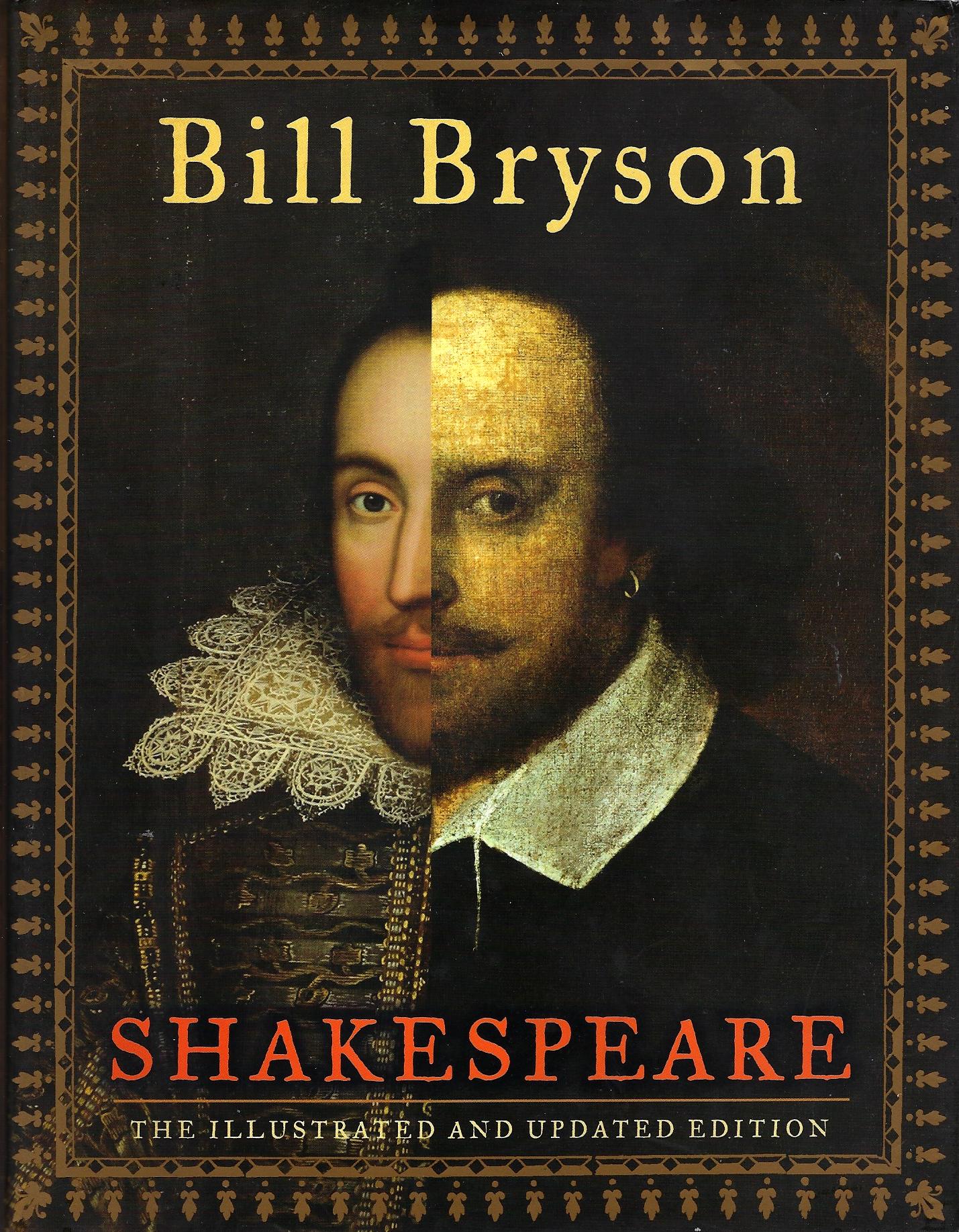
Shakespeare: The Illustrated and Updated Edition by Bill Bryson

From the description at Goodreads:

Shakespeare: The Illustrated Edition is an exquisitely illustrated, updated edition of Bill Bryson’s bestselling biography of William Shakespeare that takes the reader on an enthralling tour through Elizabethan England and the eccentricities of Shakespearean scholarship. With more than 100 color and black-and-white illustrations throughout, and updated to include recent discoveries, Shakespeare: The Illustrated Edition evokes the superstitions, academic discoveries, and myths surrounding the life of one of the greatest poets, and makes sense of the man behind the masterpieces.